Wrought iron and metal fencing is one of the most elegant and durable boundary solutions available for California homes, HOA communities, and commercial properties. Done right, a well-maintained metal fence adds architectural character, security, and long-term value to a property. Done wrong — or neglected — it becomes an eyesore, a liability, and an increasingly expensive problem to correct.
The challenge with metal fencing in California is that the same climate that makes the state so desirable to live in is genuinely hard on ferrous metals. Intense UV exposure, temperature swings between scorching summer days and cool nights, coastal salt air in western communities, and the wet-dry cycle of California's rainy season all conspire to accelerate rust and coating deterioration on metal surfaces.
The good news is that a properly prepared and coated metal fence — maintained on a reasonable cycle — will hold up beautifully for many years. The key is understanding what "properly prepared and coated" actually means, because metal fencing is one of the exterior surfaces where shortcuts in preparation and product selection create the most visible and most rapid failures.
Here's what California property owners, HOA boards, and property managers need to know about keeping wrought iron and metal fencing in top condition.
Why Metal Fencing Requires a Different Approach Than Other Exterior Surfaces
Paint applied to stucco, wood, or concrete is primarily protecting those surfaces from moisture and UV degradation. Paint applied to metal has an additional enemy to contend with: rust.
Ferrous metals — iron and steel — oxidize when exposed to moisture and oxygen. That oxidation process, which we see as rust, is not just a surface phenomenon. Rust is an electrochemical reaction that, once initiated, continues to progress beneath a coating even after the visible surface has been painted over. A coating applied over active rust doesn't stop the oxidation — it hides it while the rust continues to spread and undermine the coating from below.
This is why the preparation approach for metal fencing is fundamentally different from painting stucco or wood. The goal isn't just to clean the surface — it's to neutralize or remove oxidation so that the coating system has a clean, stable substrate to bond to, and so that the conditions that initiate rust are eliminated before the first coat of primer goes on.
Skipping or minimizing this step is the single most common reason metal fence paint jobs fail. A coating applied over inadequately prepared metal may look fine initially, but rust will begin working its way back through the surface within months — and once it appears as bubbling, staining, or lifting paint, the only correct remedy is to strip the coating back and start the preparation process over.
Step One: Assessment and Surface PreparationEvaluating the Current Condition
Before any work begins, the fence should be thoroughly assessed to understand the extent of existing rust, the condition of any existing coating, and whether any sections have deteriorated to the point of requiring repair or replacement rather than just repainting.
Minor surface rust — red-orange discoloration without significant pitting or metal loss — can typically be treated in place. More advanced rust that has caused pitting, scaling, or structural weakening of the metal may require mechanical intervention, section replacement, or welding repairs before coating work proceeds.
Existing coating that is well-bonded and in sound condition may be able to serve as a base for a new topcoat after cleaning and light abrasion. Existing coating that is peeling, bubbling, or lifting over rust must be removed back to sound material or bare metal before repriming.
Rust Removal and Treatment
Depending on the extent of rust and the type of metal, rust removal and treatment options include:
Wire brushing and hand tool preparation. For light surface rust and small areas, wire brushing by hand or with an angle grinder removes loose rust and scale and prepares the surface for treatment. This is labor-intensive but appropriate for localized rust on otherwise sound fencing.
Mechanical abrasive preparation. For more extensive rust or larger fence sections, mechanical grinding, sanding, or abrasive blasting (sandblasting or media blasting) removes rust more thoroughly and creates a surface profile that promotes coating adhesion. Abrasive blasting is the most effective preparation method for heavily rusted metal — it removes all existing coating and rust simultaneously and leaves a clean, profiled surface ready for priming.
Chemical rust treatment. Rust converter products — applied over wire-brushed surfaces — chemically react with iron oxide to form a stable, paintable compound. These products are effective for treating rust in areas that are difficult to reach mechanically, such as ornamental details, tight joints, and recessed areas on decorative fencing. They are a treatment, not a replacement for mechanical preparation where significant rust is present.
The goal of all preparation methods is the same: remove or neutralize rust so that the primer and topcoat system have a clean, stable, rust-free surface to bond to.
Cleaning
After rust treatment, the surface should be thoroughly cleaned to remove dust, grinding residue, rust converter residue, and any remaining contamination. On properties near roadways, industrial areas, or coastal environments, oil and atmospheric deposits may also be present and should be addressed with an appropriate degreasing cleaner before priming.
Step Two: Primer Selection and Application
Primer is not optional on metal fencing — it is the foundation of the entire coating system and the component most responsible for preventing rust recurrence.
Rust-Inhibiting Primers
The appropriate primer for ferrous metal fencing is a rust-inhibiting primer — formulated specifically to bond to metal substrates, provide corrosion resistance, and create a stable base for topcoats. These primers contain corrosion-inhibiting pigments that actively resist the electrochemical process that causes rust.
There are several categories of rust-inhibiting primers used in professional metal coating work:
Alkyd-based rust-inhibiting primers are widely used, provide excellent adhesion to properly prepared metal, and are compatible with a broad range of topcoats. They require adequate dry time before topcoating and are not appropriate for use over existing latex coatings.
Epoxy primers provide exceptional adhesion and corrosion resistance and are often specified for commercial and industrial metal coating applications where maximum durability is required. They are a two-component product — mixed immediately before use — and require careful application technique.
Direct-to-metal (DTM) primers and paints are single-component products formulated to be applied directly to metal without a separate primer step in some applications. While convenient, they are generally not the first choice for heavily rusted or highly exposed fencing where a dedicated rust-inhibiting primer system will outperform.
The primer should be applied to achieve the film thickness specified by the manufacturer — too thin and the corrosion protection is compromised; too thick and adhesion or drying issues can result.
Priming Hard-to-Reach Areas
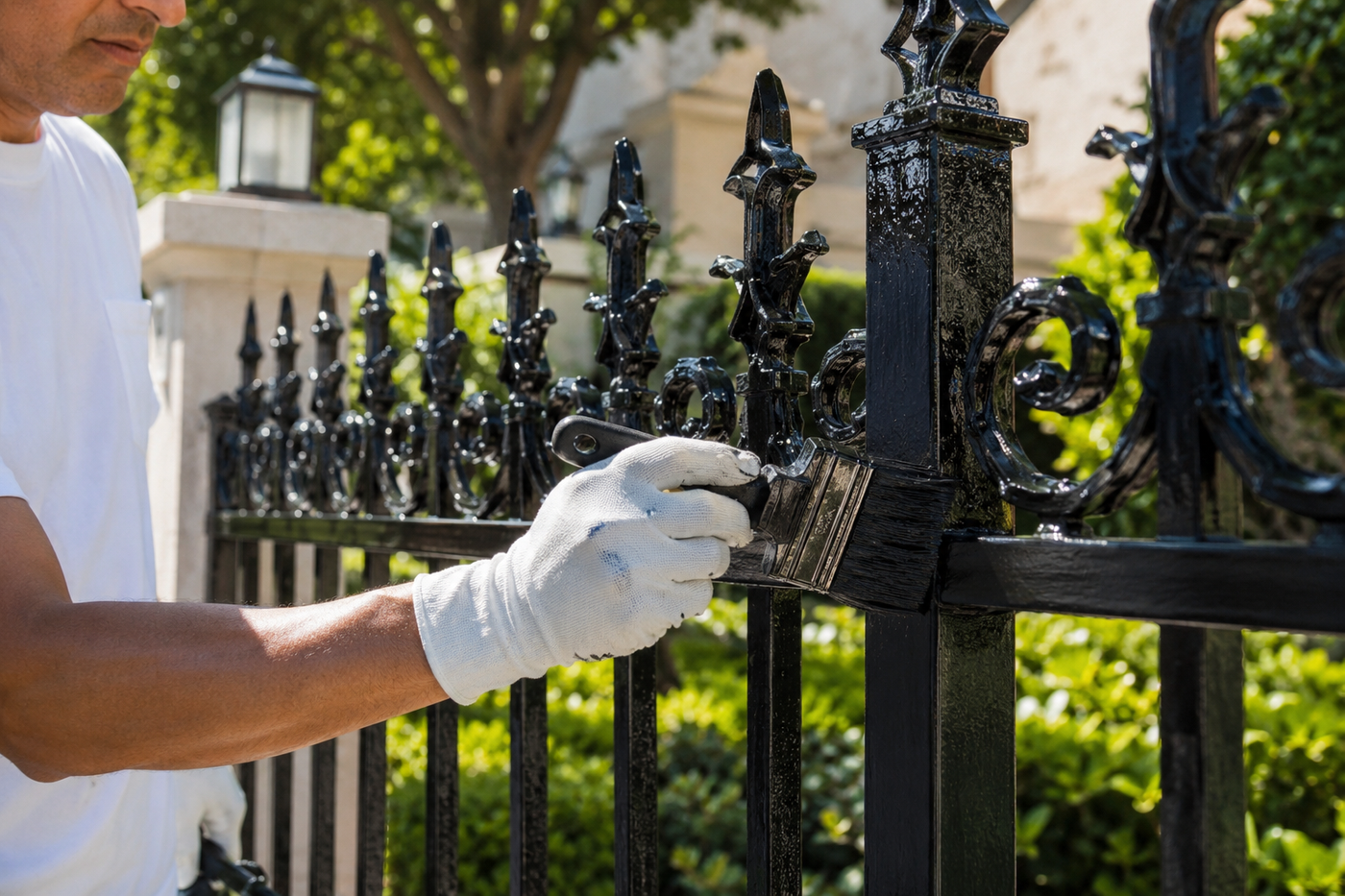
Ornamental wrought iron fencing with decorative details, tight joints, and complex profiles presents a real challenge for primer application. Brush application is typically required to work primer into recessed areas, joints, and ornamental details that a roller or spray gun can't fully reach. On decorative fencing, thorough brush priming of all surfaces — not just the visible faces — is essential for complete coverage.
Step Three: Topcoat Selection and ApplicationChoosing the Right Topcoat
The topcoat for metal fencing needs to accomplish several things simultaneously: provide UV resistance to prevent fading and chalking, maintain flexibility to accommodate thermal expansion and contraction, resist moisture penetration, and deliver an attractive finished appearance.
For most California residential and HOA metal fencing applications, a high-quality exterior acrylic enamel or alkyd enamel in a semi-gloss or gloss finish is the appropriate topcoat. These products provide:
- Good UV resistance for California's intense sun exposure
- A hard, durable film that resists chipping and abrasion
- A semi-gloss or gloss finish that sheds water effectively and looks intentional and polished on metal
- Reasonable flexibility to handle the thermal movement metal fencing experiences
For commercial or high-exposure applications — coastal properties, properties near industrial areas, or fencing that receives heavy physical contact — a two-component urethane or epoxy topcoat system provides superior durability and chemical resistance at higher cost.
Color Considerations
The most common finish color for wrought iron and ornamental metal fencing is black — and for good reason. Black is a classic, architectural choice that reads as intentional against virtually any building color or landscape, holds up well visually as it weathers, and is widely approved in HOA architectural guidelines.
That said, metal fencing is also effectively finished in dark bronze, charcoal, hunter green, and in some contemporary applications, darker earth tones. Whatever color is selected, it should be confirmed against HOA architectural guidelines before work begins.
One practical note: darker colors absorb more heat, which means dark-painted metal fencing in California's Central Valley can reach very high surface temperatures in summer. This is not a reason to avoid dark colors — they are appropriate and standard — but it is a reason to ensure the coating system specified has adequate heat resistance for the surface temperatures it will experience.
Application Method
Metal fencing can be finished by brush, roller, or spray application — or a combination of all three. Each method has tradeoffs:
Brush application provides the best penetration into tight joints, ornamental details, and recessed areas. It is time-intensive on large fence runs but is often the only effective method for complex decorative profiles.
Roller application covers flat sections of fence rail and picket efficiently but cannot reach into joints and recesses.
Spray application is the fastest method for large fence sections and produces a smooth, even finish, but requires masking of adjacent surfaces and is not effective for penetrating tight joints without supplemental brush work.
On most ornamental fencing projects, a combination approach — brush priming and detailing, spray or roller topcoat on open sections — delivers the best balance of coverage quality and efficiency.
Maintenance: How to Extend the Life of Your Metal Fence Coating
A properly prepared and coated metal fence in California should hold up well for five to seven years under typical conditions before a full recoat is warranted. The interval will be shorter in coastal or highly exposed environments and can be extended with basic annual maintenance.
Annual inspection. Walk the fence line once a year and look for areas where the coating has chipped, scratched, or begun to lift. Any bare metal exposed by damage should be treated and spot-primed as soon as possible — before rust can initiate and spread beneath the adjacent coating.
Spot touch-up. Small areas of coating damage, once cleaned and treated, can be spot-primed and touch-coated to extend the life of the overall system without a full recoat. Keeping a small quantity of the original primer and topcoat on hand for touch-up makes this straightforward.
Cleaning. Periodic washing of metal fencing — removing dirt, atmospheric deposits, and biological growth — helps the coating perform at its best and makes annual inspection easier. A mild detergent solution and a soft brush are appropriate for most fencing; avoid abrasive cleaning tools that can scratch the coating.
Address rust immediately. If rust reappears at any point — typically at areas of coating damage, at joints, or at ground contact points — address it promptly. Rust that is caught early is a spot repair. Rust that is allowed to spread becomes a recoat or a replacement.
HOA Communities: Fencing as a Community Asset
For HOA communities with wrought iron or metal perimeter fencing, entry gates, or decorative fence elements, the condition of the fencing is a significant contributor to the community's overall curb appeal and perceived value. Fencing that is rusted, faded, or showing peeling paint makes the entire community look neglected — regardless of how well the buildings themselves are maintained.
Including metal fencing in the community's regular exterior maintenance planning — on a defined inspection and recoat cycle — ensures the fencing remains an asset rather than a liability. It is also significantly less expensive to maintain fencing on a proactive cycle than to allow it to deteriorate to the point where abrasive blasting and full system restoration is required.
At Whitestone Industries, we include metal fencing assessment as part of our property condition evaluations for HOA communities and incorporate fencing recoat scopes into multi-year exterior maintenance plans where appropriate.
The Whitestone Approach to Metal Fence Painting
At Whitestone Industries, we approach metal fencing with the same commitment to preparation and product quality that we bring to every exterior surface we coat. We assess existing conditions honestly, specify the preparation method appropriate to what we find, use rust-inhibiting primer systems formulated for the substrate, and apply topcoats selected for California's climate and the specific exposure conditions of each property.
We don't paint over rust and call it done. Because we know that a coating applied over inadequately prepared metal isn't a finished job — it's a problem that will be visible again within a season.
If your home, HOA community, or commercial property has wrought iron or metal fencing that is due for attention — or if you're not sure where it stands — we'd welcome the opportunity to take a look and give you an honest assessment.
Contact Whitestone Industries today to schedule a free metal fencing assessment and estimate for your property.
Whitestone Industries serves HOAs, multifamily property owners, and commercial properties throughout California with commercial and multi-family services, commercial roofing, SB 326 and SB 721 consulting and repairs, construction defect and destructive testing, and residential services. Call us at 888-567-2234 or visit wsindustries.com.