
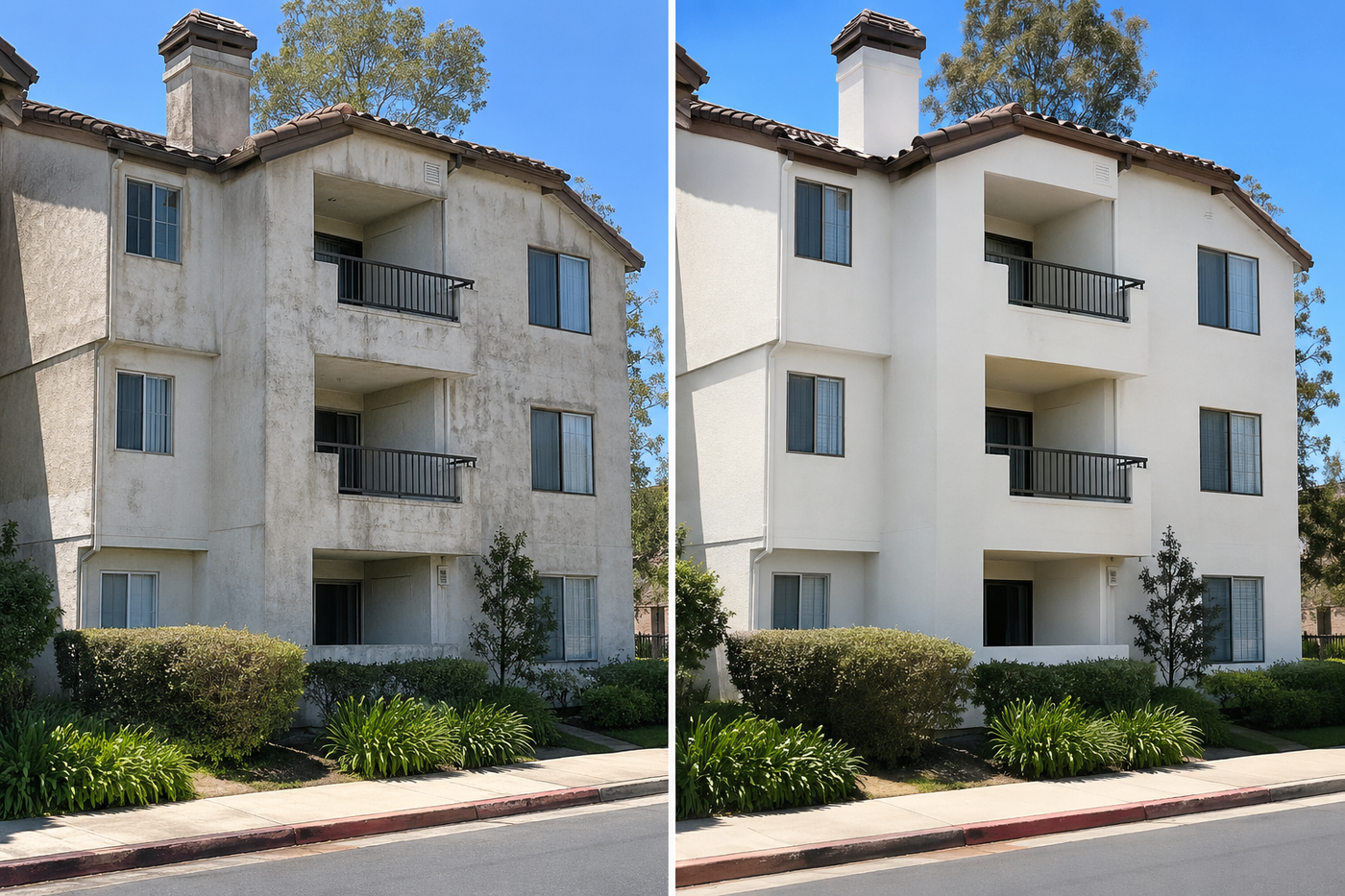
If you manage or serve on the board of an HOA community with multiple buildings, you've probably noticed it: two buildings that were constructed at the same time, with the same materials, by the same contractor — and yet one looks significantly older than the other.
The paint on Building A is faded and chalking. Building B still looks reasonably fresh. The stucco on the north side of Building C is covered in biological growth. Building D's south elevation is showing hairline cracking that Building C doesn't have. The balcony membranes on one side of the community are in reasonable shape. On the other side, they've been failing for two years.
This isn't a coincidence. And it isn't random. The variables that cause two otherwise identical buildings to age at dramatically different rates are knowable — and understanding them is one of the most useful tools an HOA board or property manager has for planning maintenance intelligently, allocating budget accurately, and avoiding the trap of treating an entire community as a uniform maintenance unit when it isn't.
Variable #1: Sun Exposure and Orientation
Of all the factors that affect how quickly an exterior coating ages, sun exposure is the most powerful — and the most predictable.
In the Central Valley and Southern California, the sun tracks from east to west with a southern arc. This means south-facing and west-facing elevations receive the most direct sun exposure and the highest UV load over the course of a day. East-facing elevations get morning sun that is less intense. North-facing elevations may receive direct sun only briefly or not at all depending on the time of year.
The practical result is that paint and coatings on south and west-facing walls degrade significantly faster than identical coatings on north and east-facing walls — even on the same building. A community where Building A faces south and Building B faces north will show dramatically different coating conditions after the same number of years, even if both buildings were painted on the same day with the same product.
This is why orientation should always be factored into condition assessments and maintenance planning. A uniform repaint schedule that treats all buildings the same regardless of their orientation will always result in some buildings being repainted too early — and others being repainted too late.
Variable #2: Shade and Tree Coverage
Trees and shade structures significantly moderate the UV and thermal load on exterior surfaces — and their presence or absence creates meaningful differences in how quickly coatings degrade and biological growth colonizes surfaces.
A building with mature trees on its south and west elevations may retain a fresh paint job significantly longer than an identical building across the street with no shade coverage. The trees intercept UV radiation, reduce surface temperatures, and moderate the thermal cycling that stresses coatings and caulking.
But shade has a flip side: shaded surfaces that don't dry quickly after rain or irrigation are more susceptible to mold, mildew, and algae growth. A north-facing elevation under a heavy tree canopy may develop biological staining significantly faster than a south-facing wall in full sun — even though the coating on the south wall is degrading faster from UV.
This means that two buildings in the same community can be developing problems at similar rates for completely different reasons — one from UV and thermal degradation, the other from biological growth and sustained moisture — and require different treatment approaches even if the visual result looks similar.
Variable #3: Irrigation and Drainage Patterns
Irrigation is one of the most under-appreciated contributors to differential building deterioration in California HOA communities — and one of the most controllable once it's identified as a problem.
Sprinkler systems that routinely wet building walls — particularly at the base of stucco, around window frames, and at balcony connections — accelerate coating deterioration, promote biological growth, and can drive moisture into the wall assembly over time. A building where irrigation heads are properly aimed away from the structure will consistently outperform an adjacent building where the sprinklers are hitting the wall at the foundation line every other day.
Drainage patterns matter as well. Buildings where grade slopes away from the foundation and water drains efficiently away from the structure are less susceptible to moisture-related deterioration at the base of walls than buildings where grade is flat or slopes toward the foundation, allowing water to pond against the stucco.
Downspout termination is another common variable. A building where downspouts discharge water away from the structure keeps the base of the wall dry. A building where downspouts are clogged, missing splash blocks, or discharge directly against the foundation creates a chronic moisture condition at the wall base that accelerates deterioration year after year.
Variable #4: Maintenance History
Perhaps the most significant variable of all — and the one most directly within a board's control — is maintenance history. Two buildings that start identical will diverge dramatically over time if one receives consistent, proactive maintenance and the other is managed reactively.
A building where caulking was replaced on a regular cycle has maintained its water resistance at windows, joints, and penetrations. A building where caulking replacement was deferred has been allowing water to work its way into the wall assembly through failed joints — and the accumulated damage from years of water intrusion shows up as staining, biological growth, soft stucco, and eventually structural deterioration that a paint job alone can't fix.
A building where minor stucco cracks were patched promptly has maintained a continuous moisture barrier. A building where the same cracks were left unaddressed has been admitting water through those cracks every rainy season — and the substrate behind them has been accumulating damage that isn't visible on the surface.
This is the compounding effect of deferred maintenance: small issues that cost little to address early become expensive problems when neglected. And the buildings in a community that have been maintained proactively will consistently look better, require less invasive repair work, and cost less to restore than buildings where maintenance has been deferred.
Variable #5: Construction Quality and Original Detailing
Not all buildings are built equally — even within the same community. Construction quality, the quality of the original waterproofing and flashing installation, the adequacy of the original caulking, and the consistency of application on the original paint job all affect how well a building holds up over time.
Buildings where the original waterproofing was properly detailed at balcony ledger connections, window heads, and penetrations will perform dramatically better over time than buildings where these details were inadequately executed — even if both buildings look identical from the street on the day of completion.
This is particularly relevant in communities built during periods of rapid construction when quality control may have been inconsistent across buildings. In these communities, it's common to find that certain buildings or certain phases of the development consistently show more problems than others — not because of how they've been maintained, but because of how they were originally built.
A thorough condition assessment that documents building-by-building variation in original construction quality is invaluable for planning and prioritizing maintenance in communities where this is a factor.
Variable #6: Occupancy and Use Patterns
How a building is used and occupied affects how quickly its exterior deteriorates in ways that aren't immediately obvious.
Buildings with higher occupancy density tend to generate more moisture — from cooking, bathing, laundry, and simply the presence of more people — that can drive vapor through the wall assembly and affect exterior coatings from the inside out. Buildings near barbecue areas, laundry facilities, or pool equipment experience grease, steam, and chemical exposure that accelerates coating deterioration on adjacent walls.
Ground-floor units with patios and planters present a unique maintenance challenge: residents who place planters directly against the building wall, run drip irrigation against the stucco, or allow organic material to accumulate at the base of the wall create localized moisture conditions that affect that building's exterior differently than adjacent buildings without these patterns.
What This Means for Maintenance Planning
Understanding that buildings in the same community age at different rates — and for identifiable reasons — has direct implications for how maintenance should be planned and budgeted.
Condition-Based Planning, Not Calendar-Based Planning
A maintenance approach that repaints every building on the same cycle regardless of actual condition is both inefficient and inadequate. It repaints buildings that don't yet need it while potentially leaving others past the point where the coating is providing meaningful protection.
A condition-based approach — grounded in a building-by-building assessment that documents actual conditions rather than assumed ones — allows maintenance to be sequenced according to real need. The buildings in worst condition get addressed first. Buildings in better condition are planned for later phases. Budget is allocated where it will have the most impact.
Understanding Root Causes, Not Just Symptoms
When a building in your community is consistently deteriorating faster than its neighbors, the answer isn't always to repaint it more frequently. The answer is to understand why it's deteriorating faster — and address the root cause.
If irrigation is hitting the wall, adjust the heads. If drainage is directing water toward the foundation, regrade or add drainage. If a specific elevation is taking extreme UV exposure, specify a higher-performance coating for that elevation. If original construction quality is the issue, include the necessary repairs in the scope rather than painting over problems that will continue to worsen.
Maintenance planning that addresses root causes alongside surface symptoms produces better outcomes and lower long-term costs than maintenance that only treats what's visible.
Building-by-Building Documentation
For HOA communities with multiple buildings, a condition assessment that documents each building individually — with photos, observations, and prioritized recommendations — is far more useful than a general community assessment that averages conditions across the property.
Building-by-building documentation allows the board to see exactly where the community stands, make informed decisions about sequencing and prioritization, communicate specific plans to homeowners, and track improvement over successive maintenance cycles.
The Value of a Contractor Who Notices
One of the most practical benefits of working with an experienced exterior contractor who knows your community well is having a second set of expert eyes that notices differential deterioration patterns before they become expensive problems.
A contractor who walks your property regularly — not just when a project is being scoped — can identify the building that's developing a drainage problem before it becomes a moisture damage claim. They can flag the irrigation head that's been hitting the stucco. They can notice that the biological growth on the north elevation of Building C is progressing faster than it was last year.
This kind of proactive observation is part of what Whitestone Industries brings to long-term HOA maintenance relationships. We don't just show up to perform the contracted work and leave. We pay attention to what's happening across your community — and we tell you what we see.
Because the best time to address a differential deterioration problem is before it becomes a differential repair bill.
Contact Whitestone Industries today to schedule a building-by-building condition assessment for your community and get a clear, honest picture of where each building stands — and why.
Whitestone Industries serves HOAs, multifamily property owners, and commercial properties throughout California with commercial and multi-family services, commercial roofing, SB 326 and SB 721 consulting and repairs, construction defect and destructive testing, and residential services. Call us at 888-567-2234 or visit wsindustries.com.