
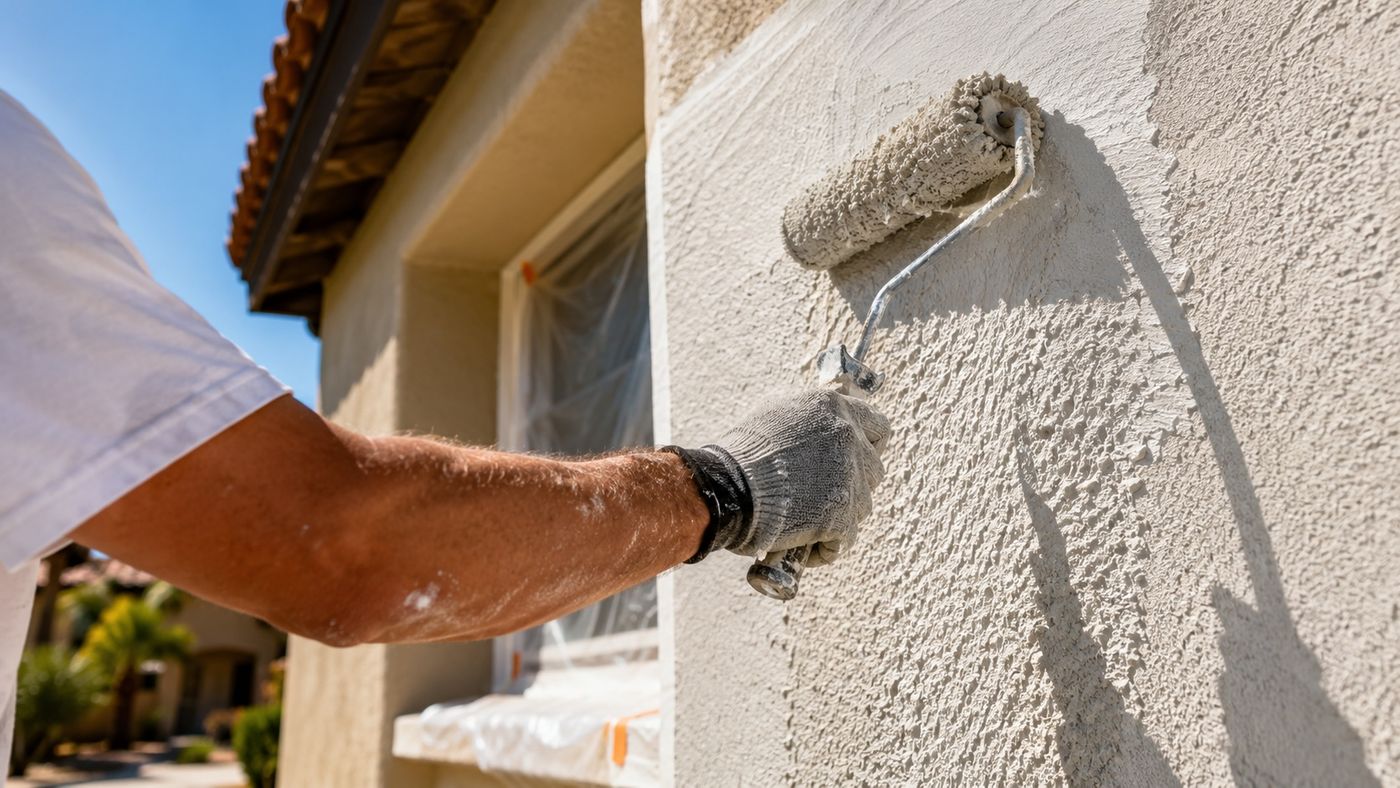
If you've ever gotten a painting estimate and seen the words "elastomeric coating" on the proposal, you may have wondered what exactly that means — and whether it's worth the extra cost.
It's a fair question. Elastomeric paint is one of the most effective exterior coating systems available for California homes, but it's not the right product for every situation. Understanding what it is, how it works, and when it makes sense can help you make a smarter decision when it's time to repaint your home.
What Is Elastomeric Paint?
Elastomeric paint is a thick, flexible exterior coating designed to stretch and return to its original shape without cracking. The name comes from the word "elastic" — and that flexibility is exactly what sets it apart from conventional exterior paint.
Where a standard exterior paint might have a dry film thickness of 1 to 2 mils per coat, elastomeric coatings typically build to 10 mils or more. That extra thickness creates a durable, waterproof membrane over the surface — much more like a protective skin than a traditional paint film.
Elastomeric coatings are formulated specifically for exterior masonry surfaces: stucco, concrete block, brick, and similar substrates. They are engineered to handle the thermal expansion and contraction that exterior surfaces experience through California's wide temperature swings, and to bridge hairline cracks that would allow moisture to penetrate a thinner coating.
How Elastomeric Paint Works
The key to elastomeric paint's performance is its elongation capability. High-quality elastomeric coatings can stretch 200 to 300 percent of their original length before returning to their normal state — meaning that as your stucco expands in the summer heat and contracts during cool nights, the coating moves with it rather than cracking.
This matters enormously in California's climate. In the Central Valley and Southern California, exterior surface temperatures can reach 150°F or higher on a hot summer day and drop dramatically overnight. Conventional paint films, which are relatively rigid once cured, can develop micro-cracks over time as they are repeatedly stressed by this thermal cycling. Each crack becomes a potential entry point for moisture.
Elastomeric coatings, by contrast, maintain their integrity through this movement cycle — sealing the surface continuously and providing a waterproof barrier that conventional paint simply cannot match over the long term.
Why Elastomeric Paint Makes Sense for California Homes. Stucco Is Everywhere — and Stucco Cracks
The vast majority of homes in Bakersfield, Fresno, the Inland Empire, and across Southern California are finished in stucco. Stucco is durable and well-suited to the California climate, but it is also prone to hairline cracking over time — particularly as homes age and experience years of thermal movement, minor settling, and seismic activity.
Hairline cracks in stucco are one of the most common pathways for water intrusion in California homes. During the rainy season, water that penetrates through cracks in the stucco can reach the weather-resistant barrier, the framing, and the interior wall assembly — leading to dry rot, mold, and costly structural repairs.
An elastomeric coating applied over a properly prepared stucco surface bridges these hairline cracks and provides a continuous waterproof membrane that dramatically reduces the risk of moisture intrusion. For homeowners with aging stucco, or stucco that has developed a network of fine surface cracks, elastomeric is often the right product choice.
California's Sun Is Hard on Conventional Coatings
UV radiation is one of the primary enemies of exterior paint. In California's intense sun — especially in inland areas that don't benefit from coastal moderation — conventional paint films break down faster than in cooler or cloudier climates. The UV degradation process causes paint to oxidize, chalk, and lose adhesion over time.
High-quality elastomeric coatings are formulated with UV-resistant resins and pigments that hold up better under prolonged sun exposure. Because the coating is also significantly thicker than conventional paint, there is simply more material to degrade before the substrate is exposed — extending the effective service life of the coating.
Moisture Resistance That Goes Beyond Paint
Elastomeric coatings are waterproof in a way that conventional paint is not. While a good exterior paint provides meaningful water resistance, an elastomeric coating forms a true moisture barrier — preventing liquid water from penetrating the surface even under sustained exposure.
For homeowners in areas that experience heavy rain events, or for homes with west or south-facing elevations that take the brunt of wind-driven rain, the additional moisture protection of an elastomeric system provides meaningful long-term value.
When Elastomeric Paint Is the Right Choice
Elastomeric coating is particularly well-suited for your home when:
Your stucco has hairline cracking. If your exterior shows a network of fine cracks — whether from age, settling, or thermal movement — elastomeric is designed to bridge and seal these cracks, preventing water from using them as an entry point.
Your home hasn't been painted in ten or more years. Older stucco surfaces that have gone through many cycles of expansion and contraction often benefit from the additional flexibility and film build of an elastomeric system.
You've had moisture-related issues. If you've experienced water intrusion through exterior walls, efflorescence (white salt deposits on stucco), or interior moisture issues related to the building envelope, an elastomeric coating is worth considering as part of a broader remediation approach.
Your home is in a high-UV exposure area. Homes in the Central Valley and inland Southern California — areas with intense sun and extreme summer temperatures — are good candidates for elastomeric coatings due to the product's superior UV resistance and thermal flexibility.
You want a longer interval between repaints. Because elastomeric coatings are thicker and more durable than conventional paint, a properly applied elastomeric system can extend the repaint cycle — providing long-term cost savings even though the upfront material cost is higher.
When Elastomeric Paint Is NOT the Right Choice
Elastomeric coating is not the right product for every situation, and applying it incorrectly can create problems.
Over surfaces with active moisture issues. Elastomeric coatings are designed to keep moisture out — but if moisture is already trapped within the wall assembly, sealing the surface can trap it inside, making the problem worse. Active moisture issues need to be identified and resolved before an elastomeric coating is applied.
Over surfaces with failing existing coatings. An elastomeric coating applied over peeling or poorly bonded existing paint will fail along with the underlying material. Surface preparation — including removing failing coatings, repairing damaged stucco, and properly priming — is essential before application.
On wood siding. Elastomeric coatings are formulated for masonry surfaces. They are generally not the right choice for wood siding or trim, where a high-quality acrylic latex paint is typically more appropriate.
When the existing coating is incompatible. Not all elastomeric products are compatible with all existing coatings. A professional contractor should evaluate the existing surface condition and coating history before recommending an elastomeric system.
What to Expect From an Elastomeric Paint Job
If you and your contractor determine that an elastomeric coating is the right choice for your home, here's what the process should look like:
Thorough surface preparation. This includes pressure washing the entire exterior, scraping and removing any loose or failing paint, repairing stucco cracks and damage, caulking around windows, doors, and penetrations, and priming bare or repaired areas as needed. This prep work is non-negotiable — the performance of the elastomeric system depends entirely on a clean, sound substrate.
Proper product selection. There are many elastomeric products on the market at different price and performance points. A qualified contractor should specify a product appropriate for your surface type, climate, and performance goals — not simply the least expensive option.
Application at the correct thickness. Elastomeric coatings must be applied at the thickness specified by the manufacturer to achieve their rated performance — including crack-bridging capability and waterproofing. Applying elastomeric too thin defeats much of the purpose of using it. This typically means two coats applied at the correct spread rate.
Realistic expectations on appearance. Elastomeric coatings have a slightly different texture and sheen than conventional paint. A good contractor will help you understand what the finished surface will look like before the work begins.
The Bottom Line
For California homeowners with stucco exteriors — particularly in the Central Valley and inland Southern California — elastomeric coating is often one of the smartest long-term investments you can make in your home's exterior. It provides superior crack bridging, waterproofing, and UV resistance compared to conventional paint, and when properly applied, it can extend the service life of your exterior coating system and reduce long-term maintenance costs.
That said, it's not a one-size-fits-all solution. The right product choice depends on your home's current condition, the existing coating system, and your specific performance goals — which is why a thorough on-site evaluation matters before any product is specified.
At Whitestone Industries, we assess every residential painting project individually. We'll evaluate your exterior, discuss your options honestly, and recommend the coating system that makes the most sense for your home — whether that's a premium elastomeric, a high-quality acrylic latex, or a combination approach for different surfaces.
Contact Whitestone Industries today to schedule a free residential painting consultation and find out whether elastomeric coating is right for your home.
Whitestone Industries serves HOAs, multifamily property owners, and commercial properties throughout California with commercial and multi-family services, commercial roofing, SB 326 and SB 721 inspections and consulting, construction defect and destructive testing, and residential services. Call us at 888-567-2234 or visit wsindustries.com.