
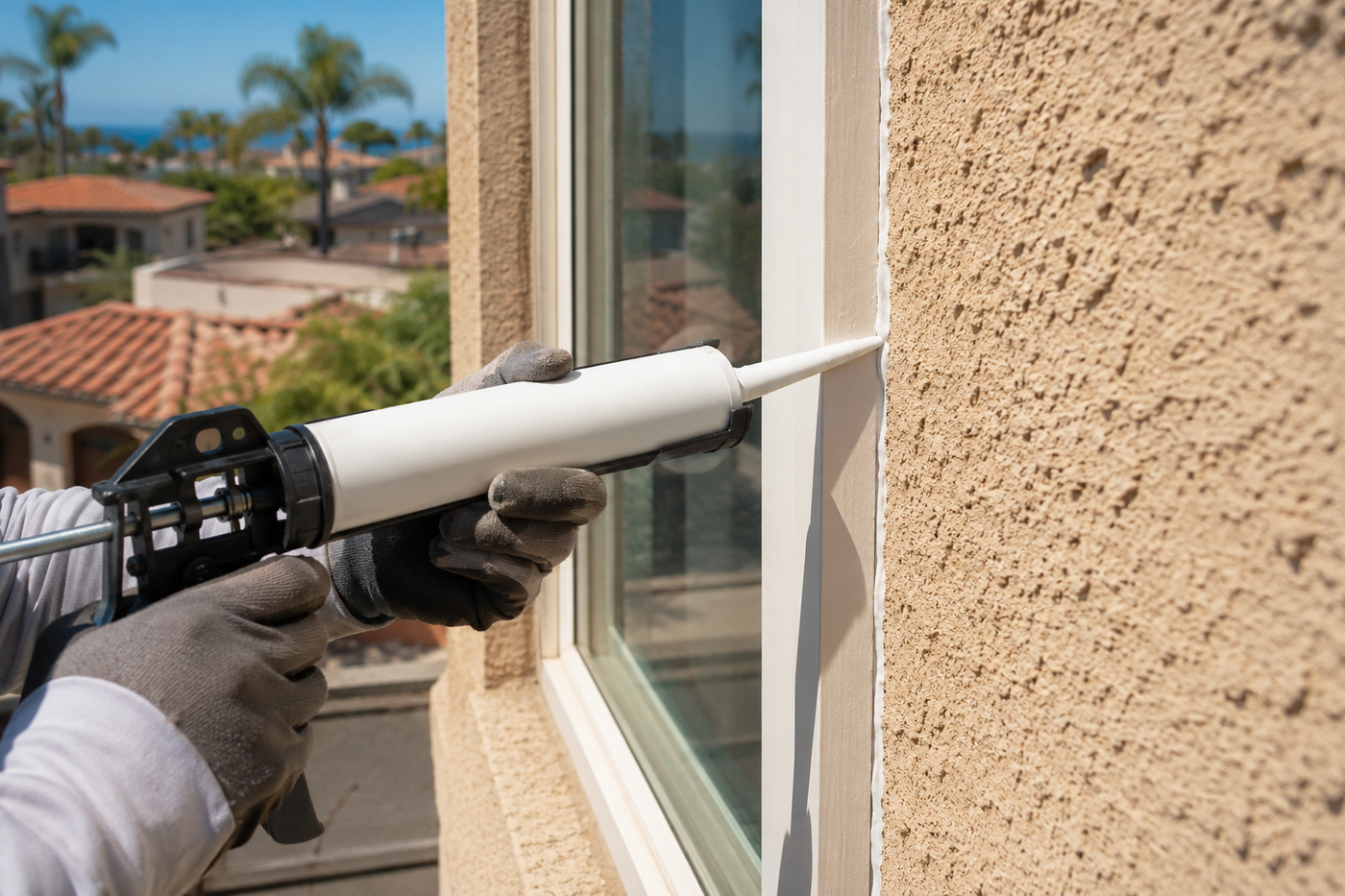
If you've ever watched a contractor work on a building's exterior, you've probably seen someone with a caulk gun moving methodically along window frames, door surrounds, control joints, and wall penetrations — applying a bead of sealant that gets smoothed into place and then largely forgotten.
It's easy to overlook caulking. It's not the dramatic part of an exterior project. It doesn't transform the appearance of a building the way a fresh coat of paint does. It doesn't carry the technical complexity of a waterproofing membrane system or a roofing replacement.
But here's the reality: caulking is one of the most important components of your building's exterior — and failed caulking is one of the most common causes of water intrusion, structural damage, and premature coating failure on California properties.
A building with a fresh, well-applied exterior paint job and failed caulking at the windows is a building that is letting water into its wall assembly every time it rains. A community that has invested in balcony waterproofing but ignored the caulking at the ledger connections is a community that still has a water intrusion problem.
Understanding what caulking is, where it lives, how it fails, and what a proper caulking program looks like is one of the most practical things a property owner, HOA board member, or property manager can do to protect their building investment.
What Is Caulking?
Caulking — also called sealant — is a flexible, waterproof material used to seal gaps, joints, and transitions between building materials on a structure's exterior. Its primary purpose is to prevent air and water from penetrating the building envelope through the inevitable gaps that exist where different materials meet, where surfaces expand and contract at different rates, and where the building moves over time.
Caulking is not the same as grout, mortar, or putty — though all of these are used to fill gaps in construction. What distinguishes caulking is its flexibility. Unlike rigid fillers that crack when subjected to movement, quality exterior caulking is formulated to remain flexible after curing — stretching and compressing as the building moves without losing its seal.
This flexibility is what makes caulking so important in California's climate, where buildings experience significant thermal movement as surfaces expand in summer heat and contract in cooler temperatures, and where seismic activity causes subtle but cumulative movement in building assemblies over time.
Where Caulking Lives on Your Building
Caulking appears in more locations on a typical California building than most property owners realize. Understanding where it is — and what it's doing in each location — helps you appreciate why a comprehensive caulking program matters.
Windows and Doors
The joint between a window or door frame and the surrounding wall is one of the most critical caulking locations on any building. This joint is subject to constant movement as the window frame and wall expand and contract at different rates, and it is directly exposed to wind-driven rain that can force water into even a small gap.
Failed caulking at window heads — the joint at the top of the window frame — is one of the most common sources of water intrusion in California residential and multifamily properties. Water that enters at the window head can travel down inside the wall cavity, saturating insulation and framing before it becomes visible as interior staining or damage.
Control Joints
Stucco and concrete exteriors incorporate control joints — planned breaks in the surface that allow the material to expand and contract without cracking randomly. These joints are designed to move, which means they must be sealed with a flexible caulking product rather than a rigid filler.
Caulking in control joints is under constant stress as the stucco or concrete moves seasonally and daily. Over time, this movement causes the caulking to harden, debond from one or both sides of the joint, and eventually crack or pull away — leaving a direct path for water to reach the substrate behind the stucco.
Penetrations
Every pipe, conduit, cable, vent, scupper, and mechanical penetration through an exterior wall or roof surface is a potential water entry point if not properly sealed. Caulking around penetrations keeps water from tracking along the outside of pipes and conduits and into the wall assembly.
This is particularly important around HVAC equipment, plumbing vents, electrical conduits, and hose bibs — all of which penetrate the building envelope at points that are often overlooked in routine maintenance.
Balcony and Deck Connections
The connection between a balcony or deck structure and the building wall — called the ledger connection — is one of the highest-risk caulking locations on multifamily properties. Water that gets behind the waterproofing membrane at this transition can travel along the ledger and into the wall framing, causing exactly the kind of structural damage that SB 326 and SB 721 inspections are designed to identify.
Proper caulking and flashing at balcony ledger connections is a critical component of a complete waterproofing system — and its absence or failure is a finding that should be addressed immediately.
Roofing Transitions and Flashings
At roof edges, parapet walls, skylights, HVAC curbs, and anywhere a roofing membrane transitions to a vertical surface or penetration, caulking plays a supporting role alongside flashing in keeping water out. Failed caulking at roofing penetrations is one of the most common sources of roof leaks — and one of the easiest to overlook because the failure point is often hidden beneath equipment or at a transition that isn't visible from ground level.
Expansion Joints
Larger buildings and HOA communities with multiple connected structures often have expansion joints — larger planned breaks in the building assembly that accommodate significant structural movement. These joints require specialized backer rod and flexible sealant systems capable of handling larger movement cycles than standard control joint caulking. Failed expansion joint sealant is a significant water intrusion risk and should be included in any comprehensive exterior maintenance assessment.
How Caulking Fails
Understanding how caulking fails helps you recognize the warning signs before failure leads to water damage.
Hardening and Loss of Flexibility
All exterior caulking products cure over time from a flexible state to a progressively harder, more rigid condition. UV exposure, heat, and weathering accelerate this process. As caulking loses its flexibility, it can no longer accommodate the movement of the joint it's sealing — and it begins to crack, pull away from the substrate, or both.
In California's Central Valley and inland Southern California, where UV exposure and temperature extremes are particularly intense, this hardening process happens faster than in more moderate climates. Caulking that might last ten years in a coastal California community may need attention in five to seven years in Bakersfield.
Adhesion Failure
Caulking bonds to the surfaces on either side of the joint it's sealing. When that bond fails — due to inadequate surface preparation before application, incompatible substrate materials, moisture at the time of application, or simply age — the caulking pulls away from one or both sides of the joint, leaving a gap even if the caulking itself hasn't cracked.
Adhesion failure is particularly common at painted surfaces, where caulking bonds to the paint film rather than the substrate beneath it. When the paint eventually releases or deteriorates, the caulking goes with it.
Shrinkage and Cracking
Some caulking products shrink as they cure, pulling away from the edges of the joint and creating gaps at the bonding surfaces. Shrinkage cracking is also common in caulking that has been applied in too thick a bead without proper backing — the material cures on the outside while remaining soft inside, eventually cracking as the outer skin can't accommodate the movement of the uncured interior.
Biological Growth
In shaded locations, north-facing elevations, and areas with irrigation overspray, exterior caulking can become colonized by mold and mildew. While biological growth on the surface of caulking is primarily aesthetic, it can accelerate the degradation of the material and is often a sign that the joint is already allowing some moisture penetration.
What a Proper Caulking Program Looks LikeRegular Inspection
Caulking should be inspected on a regular cycle — ideally annually as part of a broader exterior maintenance walkthrough. What to look for:
Cracking. Any crack in caulking that extends through the full depth of the bead is a failed seal — water will find it.
Debonding. Caulking that has pulled away from one or both sides of the joint, even if it hasn't cracked, is no longer sealing the joint effectively.
Hardness. Properly functioning exterior caulking should feel somewhat flexible when pressed with a fingernail. Caulking that is completely rigid and unyielding is approaching the end of its effective life even if visible cracks haven't appeared yet.
Shrinkage and gaps. Caulking that has visibly shrunk away from the edges of a joint, or that shows daylight through any portion of the sealed area, has failed.
Removal and Replacement — Not Caulking Over Caulking
One of the most common mistakes in caulking maintenance is applying new caulking over existing failed caulking rather than removing it and starting fresh. New caulking applied over old, failed caulking bonds to the degraded material rather than the substrate — and will fail along with it, often sooner than the original.
Proper caulking replacement involves:
Removing the existing caulking completely using a utility knife, oscillating tool, or caulk removal tool. This is time-consuming but essential.
Cleaning the joint to remove any remaining caulking residue, dirt, and contamination that would interfere with adhesion of the new material.
Installing backer rod in joints wide enough to require it — a foam backing material that controls the depth of the caulking bead and ensures proper joint geometry for maximum flexibility and adhesion.
Applying the new caulking in a continuous, properly tooled bead that fully contacts both sides of the joint and is shaped to promote water shedding rather than water collection.
Product Selection
Not all caulking products are appropriate for all applications. Using the wrong product is a common cause of premature failure.
Siliconized acrylic latex (also called painter's caulk or acrylic caulk) is the most widely used product for general exterior caulking on painted surfaces. It is paintable, easy to apply and tool, and performs well in most above-grade exterior applications. It is not appropriate for joints subject to large movement or sustained water immersion.
Polyurethane sealants provide superior flexibility, adhesion, and durability compared to acrylic latex products and are the appropriate choice for control joints, expansion joints, and high-movement applications. They are more difficult to apply and tool than acrylic products and require more careful surface preparation — but they outperform acrylic latex in demanding applications.
Silicone sealants provide excellent UV and weather resistance and remain flexible over a wide temperature range. However, standard silicone cannot be painted, which limits its use on exterior applications where the caulking will be overcoated. Paintable silicone and hybrid silicone-polyurethane products bridge this gap in some applications.
Traffic-grade and horizontal sealants are specifically formulated for horizontal surfaces subject to foot or vehicle traffic — pool deck joints, control joints in paved areas, and similar applications where standard caulking would be damaged by traffic.
A qualified contractor will specify the appropriate product for each joint type and application — not simply apply the same product everywhere regardless of the demands of each location.
Caulking and Painting: Why They Go Together
On any exterior painting project, caulking replacement should be included in the scope — not treated as an optional add-on. Here's why:
Fresh paint applied over failed caulking immediately undermines the value of the paint job. Water that enters through failed caulking will work its way behind the new coating, causing premature peeling, blistering, and staining at the very locations that were just freshly painted.
Conversely, new caulking applied after painting bonds to the fresh paint film rather than the substrate — and will release when the paint eventually releases. The correct sequence is: prepare surfaces, repair damage, replace caulking, prime, then apply finish coats. The new caulking is integrated into the coating system, not applied over the top of it.
A contractor who separates caulking from the painting scope — or who doesn't include caulking replacement as a standard component of an exterior repaint — is not approaching the project as a system. And an exterior that isn't treated as a system won't perform like one.
The Whitestone Approach to Caulking
At Whitestone Industries, caulking is never an afterthought. On every exterior project we perform — whether it's a full community repaint, a waterproofing rehabilitation, or a targeted repair scope — we assess the condition of all caulked joints, specify the appropriate replacement products for each application, and perform proper removal and replacement rather than applying new caulking over old.
We treat caulking the way it deserves to be treated: as a critical component of the building envelope, not a cosmetic detail.
If your property hasn't had a comprehensive caulking assessment recently — or if you've noticed cracking, gaps, or water staining at window frames, control joints, or penetrations — we'd welcome the opportunity to take a look and give you an honest picture of where things stand.
Contact Whitestone Industries today to schedule a free exterior assessment and find out what your building's caulking is actually telling you.
Whitestone Industries serves HOAs, multifamily property owners, and commercial properties throughout California with commercial and multi-family services, commercial roofing, SB 326 and SB 721 consulting and repairs, construction defect and destructive testing, and residential services. Call us at 888-567-2234 or visit wsindustries.com.