
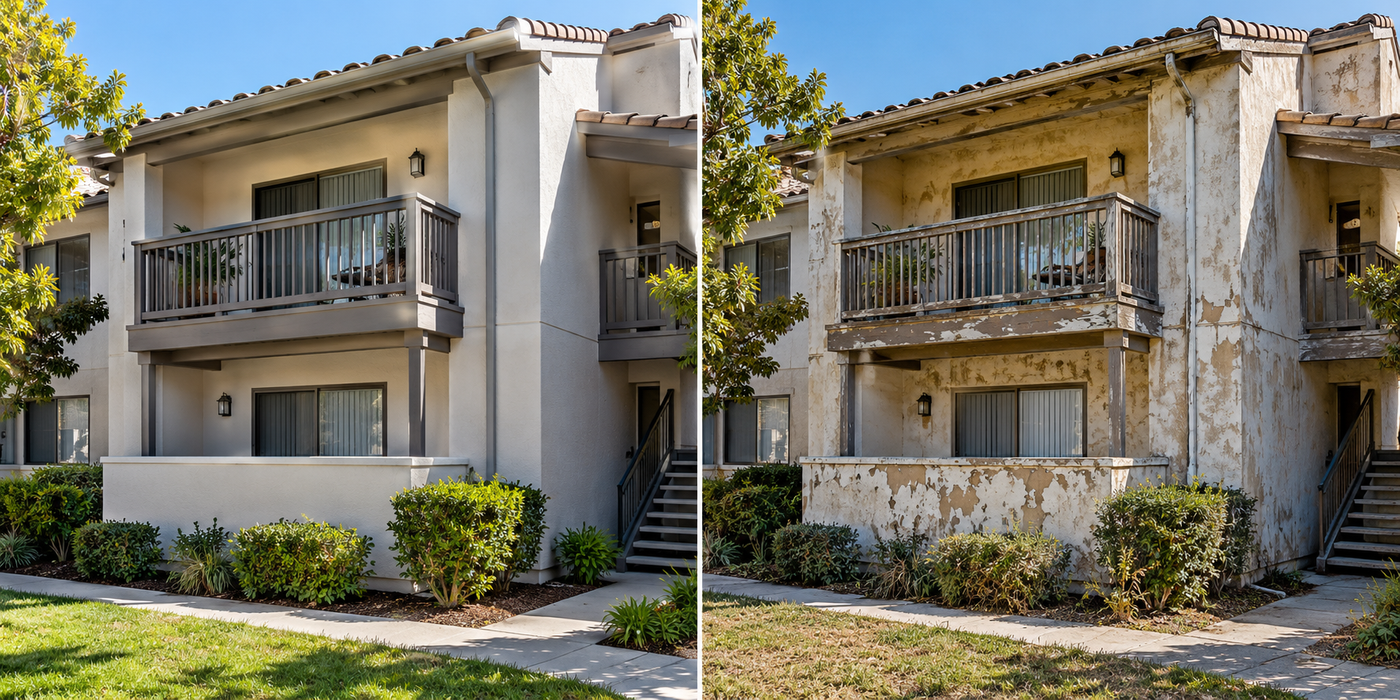
Every HOA board has faced the conversation at some point. The reserve fund is tight. Assessments are already drawing complaints. The building looks okay — not perfect, but okay. Maybe the exterior repaint can wait another year. Maybe the caulking replacement can be pushed to next cycle. Maybe the roofing inspection can be deferred until something actually starts leaking.
It's a tempting calculation. And it almost always costs the association significantly more than the money it saved.
Deferred exterior maintenance is one of the most expensive decisions an HOA board can make — not because the work itself becomes more expensive (though it does), but because the damage that accumulates during the deferral period creates an entirely new set of problems that weren't in the original scope. What would have been a $40,000 maintenance project in year one can easily become a $120,000 rehabilitation project in year five.
Here's what actually happens to a California multifamily building's exterior when routine maintenance is skipped — year by year.
Year One: Small Problems, Low Stakes
In the first year after maintenance is deferred, visible changes are minimal. The building may look a little worn. Paint that would have been refreshed starts showing the beginning of UV degradation — slight chalking, early fading. A few caulk joints around windows are getting stiff and developing hairline separation, but they haven't opened up enough to let water through yet.
The roofing system is another year older, but flashings are still mostly intact. Waterproofing membranes on balconies are showing some surface wear but haven't blistered or delaminated.
At this stage, the cost to get current is roughly what it would have been the year before. The board has deferred the work without materially increasing what it will cost to do it right.
The illusion: Everything looks manageable. The decision to defer feels validated.
Year Two: Coatings Begin to Fail
By year two, paint that was approaching the end of its service life has now crossed into active failure. UV degradation has progressed from chalking to visible oxidation. The coating has lost adhesion in spots — particularly on south and west-facing elevations that absorb the most sun. On close inspection, you can see areas where the paint has separated from the substrate.
Caulk joints that were marginal last year have now opened. Gaps around windows, door frames, and wall penetrations are visible. During the rainy season, water is entering the wall assembly at these points — slowly, in small quantities, but consistently.
Waterproofing membranes on balconies and deck surfaces are beginning to blister in areas of concentrated UV exposure. The blisters are small, but they indicate that the membrane bond is compromised and moisture vapor is working beneath the surface.
What's changed: The scope of work has grown. Repair of failed caulk and spot treatment of delaminating paint areas are now part of the prep work before any recoating can happen. The cost estimate is 15 to 25 percent higher than it was in year one.
Year Three: Water Is Getting In
Year three is where deferred maintenance shifts from an aesthetic problem to a structural one.
Failed caulk joints have now been through two or three rainy seasons without being addressed. Water has been infiltrating wall assemblies around windows, at deck ledger connections, and at wall penetrations consistently. The weather-resistant barrier behind the stucco — which was designed to drain incidental moisture, not to act as the primary waterproofing layer — is beginning to show signs of saturation in affected areas.
In some locations, moisture has reached the framing. Early-stage wood rot is developing in sill plates and framing members behind windows where caulk has been open the longest. At this point, the damage isn't yet structural — but it's getting there.
Waterproofing membrane failures on balconies have expanded. What were small blisters in year two are now larger delaminated areas with visible cracking. During rain events, water is reaching the structural deck below the membrane. On any elevated walking surface, this is the condition that SB 326 and SB 721 inspections are specifically designed to identify and address.
The roofing system, if it hasn't been inspected, may have flashings that have lifted, shifted, or separated at penetrations. The first significant rain event of the season may reveal this with an interior leak — the most expensive way to learn the roof needs attention.
What's changed: The project now includes substrate repair. Framing replacement, waterproofing system tear-out and reinstallation, and stucco removal and reapplication in affected areas are being added to a scope that originally would have been coatings and caulking. Cost is now 50 to 75 percent higher than the year-one estimate — and that's before concealed conditions are opened up.
Year Four: The Scope Expands Beyond What a Paint Contractor Can Handle
By year four, the exterior work that a painting contractor could have handled as a straightforward repaint project has become a multi-trade rehabilitation project.
Framing damage has progressed. What was early-stage rot in year three has advanced to structural degradation in the most affected areas. The scope now requires a contractor with General Building (B license) capability — not just a painting subcontractor — because the work involves structural framing repair, not just surface treatment.
Balcony conditions on properties subject to SB 326 or SB 721 have likely crossed from deferred maintenance into mandatory repair territory. If an inspection has been triggered — either by the legal timeline or by a visible condition that drew resident complaints — the inspection report may identify elevated elements that require immediate remediation, creating an emergency timeline that eliminates the board's ability to plan, budget, or bid the work competitively.
Paint failure is now widespread. Peeling, chalking, and delaminated areas cover significant portions of the building's elevations. In addition to the coating work itself, the prep required before a new coating can be applied includes removal of all failed material — a labor-intensive process that adds substantially to the repaint cost.
Stucco that has been absorbing moisture for two or more years is beginning to show visible signs: efflorescence (white salt deposits), staining, and surface deterioration in areas of concentrated water intrusion. Some stucco areas will need to be removed and replaced before a new coating can be applied.
What's changed: The project has doubled in scope from what it was in year one. The board is now looking at a multi-phase rehabilitation project that requires sequencing — structural repairs before waterproofing, waterproofing before stucco, stucco before paint — adding project management complexity and duration.
Year Five: Emergency Response Mode
By year five of deferred maintenance, the HOA is no longer managing a maintenance project. It is responding to a building condition emergency.
Interior water damage is likely present in at least some units. Residents are reporting staining, mold, and moisture-related issues to the board. The association may be receiving demand letters from homeowners whose units have been damaged by water intrusion that originated in deferred exterior maintenance — a liability exposure that the association's insurance carrier will scrutinize carefully.
Structural framing damage in the most affected areas has progressed to the point where load-bearing capacity may be compromised. Elevated elements — balconies, stairways, walkway covers — may need to be taken out of service pending repair to address life-safety concerns.
The reserve fund, if it was already underfunded at year one, is almost certainly inadequate for the scope of work now required. The board is facing difficult choices: a special assessment, an HOA loan, or a phased repair program that addresses the most critical safety items first while the rest of the building continues to deteriorate.
The total cost of the year-five rehabilitation — structural repairs, waterproofing system replacement, stucco remediation, roofing repairs, exterior recoating, and associated permitting, engineering, and project management — will typically run two to four times what the original maintenance program would have cost in year one.
What's changed: Everything. The project that was deferred to save money has now cost the association multiples of what proactive maintenance would have required — and created resident relations, liability, and legal complications that go well beyond the construction work itself.
The Real Math of Deferred Maintenance
Here's a simplified illustration of how deferral compounds cost on a hypothetical 50-unit multifamily community:
Year 1 — Proactive maintenance program: Exterior repaint, full caulking replacement, balcony waterproofing inspection and minor repairs, roofing inspection and flashing tune-up: ~$85,000
Year 5 — Deferred maintenance rehabilitation: Structural framing repairs (multiple locations), full waterproofing system tear-out and replacement on all elevated elements, stucco removal and reapplication in moisture-affected areas, exterior repaint with extended prep, roofing repairs including flashing replacement, engineering and permitting fees, potential interior remediation in affected units: ~$220,000 to $300,000
The $85,000 that felt like it could wait has become a $220,000 to $300,000 project — plus the liability exposure, resident relations issues, and potential special assessment that come with it.
What Proactive Boards Do Differently
The boards that avoid this cycle aren't necessarily the ones with the most money. They're the ones who treat exterior maintenance as a continuous program rather than a series of one-time decisions.
They maintain a rolling 3-year maintenance plan. Rather than evaluating exterior conditions reactively, proactive boards work from a documented maintenance schedule that identifies upcoming work in advance, allowing time to budget, plan, and bid competitively.
They get professional condition assessments regularly. A qualified contractor walking the property annually — looking at coatings, caulking, waterproofing, roofing, and drainage — provides an early warning system that identifies conditions before they progress into structural problems.
They fund reserves based on reality. Reserve studies that are updated with current pricing and actual inspection findings — not general assumptions — give boards the financial information they need to make honest funding decisions.
They treat maintenance as risk management. The question isn't whether the building needs to be painted. It's whether the association can afford the liability and structural damage that comes with not painting it on schedule.
Whitestone Can Help You Get Ahead of It
At Whitestone Industries, we work with HOA boards across California who are in every stage of this cycle — from proactive maintenance planning to emergency rehabilitation after years of deferral. We understand both what good maintenance looks like and what it costs when it gets away from a community.
We offer professional condition assessments that give boards a clear, documented picture of where their building stands — what's in good shape, what needs attention soon, and what can reasonably wait. That information is the foundation of a maintenance plan that protects the community's assets and keeps costs predictable.
If your community hasn't had a professional exterior assessment recently — or if you're looking at deferred maintenance and trying to understand what it will actually take to get current — we'd welcome the conversation.
Contact Whitestone Industries today to schedule a property assessment and get a realistic picture of your building's current condition and what proactive maintenance will cost versus what continued deferral will.
Whitestone Industries serves HOAs, multifamily property owners, and commercial properties throughout California with commercial and multi-family services, commercial roofing, SB 326 and SB 721 consulting and repairs, construction defect and destructive testing, and residential services. Call us at 888-567-2234 or visit wsindustries.com.