
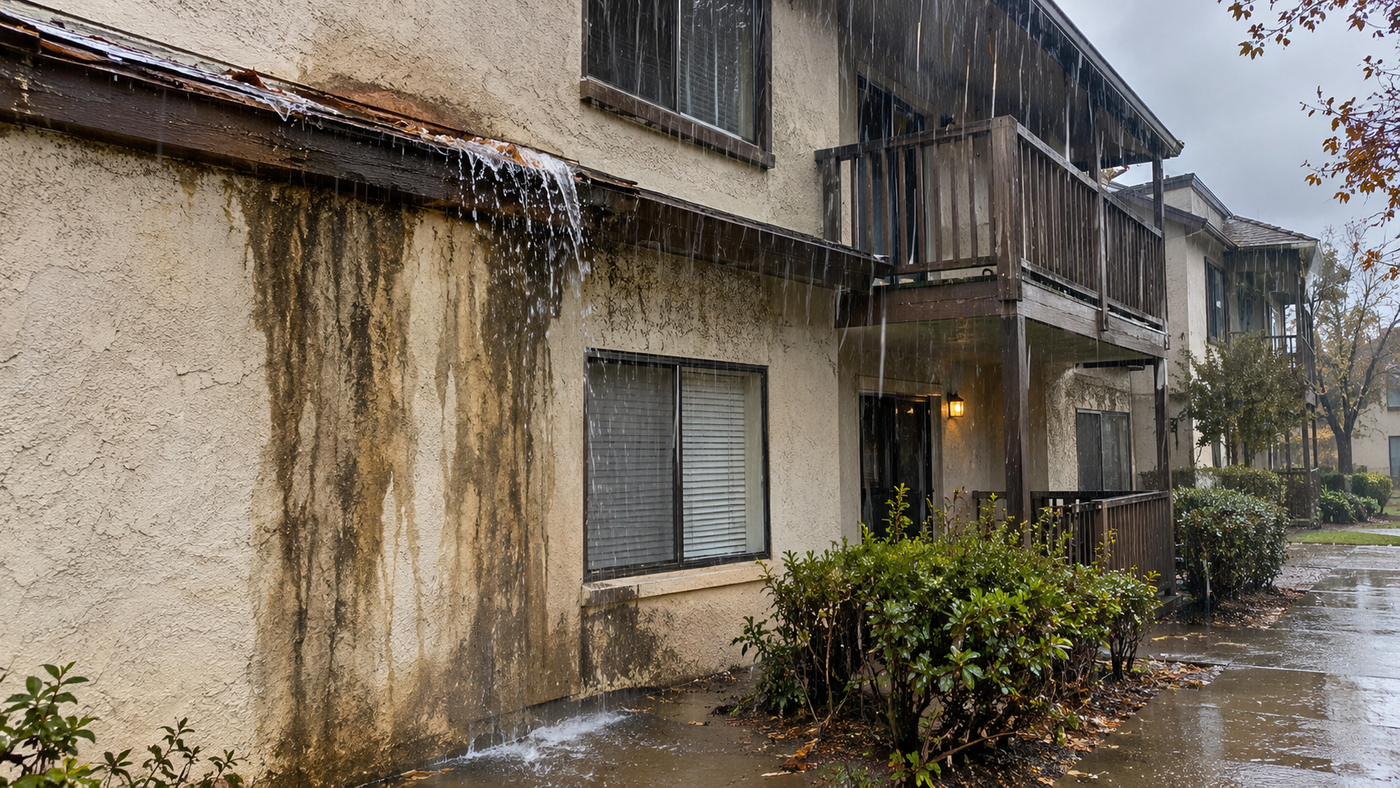
California's dry season creates a false sense of security.
For six to eight months every year, the sun bakes your building's exterior relentlessly — fading paint, hardening caulk, opening hairline cracks in stucco, stressing waterproofing membranes, and shifting flashings at roof edges. But because it doesn't rain during all of that, the damage accumulates quietly. The building keeps looking okay. Water problems don't announce themselves until there's water.
Then November arrives. And the rains come looking for every weakness the summer left behind.
For property owners and HOA boards who kept up with exterior maintenance, the rainy season is just weather. For those who deferred it, the rainy season is an audit — and it doesn't grade on a curve.
Here's what actually happens to a neglected building exterior when California's wet season arrives, and what it costs when the problems surface.
Failed Caulk: Every Gap Becomes a Water Entry Point
Exterior caulking around windows, doors, wall penetrations, and control joints is your building's first line of defense against water intrusion. During California's summer, that caulking is subjected to intense thermal cycling — heating and expanding during the day, cooling and contracting at night, over and over for months.
By the time fall arrives, caulk that was already aging has often hardened, shrunk away from the surfaces it was bonding, or developed cracks that aren't visible until you're looking closely. From a distance, the building looks fine. Up close, the gaps are there.
When rain arrives, those gaps don't filter water — they channel it. Wind-driven rain finds every open joint and forces water directly into the wall assembly behind the caulk line. The water reaches the weather-resistant barrier, the framing, the insulation. If the weather-resistant barrier is intact and properly lapped, some of it drains away. If it has been compromised by years of moisture cycling, more of it stays.
The result: water-damaged framing, saturated insulation, and eventually interior moisture problems — staining, mold, and unit damage that homeowners and tenants report to the board or the property manager.
Replacing caulk before the rains arrive costs a few thousand dollars on a typical multifamily property. Remediating the water damage it allows in — framing repair, stucco removal and reapplication, interior drywall and mold remediation — costs dramatically more.
Stucco Cracks: Summer Opens Them, Winter Fills Them
Stucco is an excellent exterior finish for California's climate, but it is not impervious to the thermal movement that California's temperature swings create. Over a long, hot summer — especially in the Central Valley where surface temperatures on stucco walls can exceed 150°F during peak heat — hairline cracks develop at corners, around openings, and along control joints.
These cracks are easy to dismiss. They're small. The building looks structurally sound. And during the dry season, they cause no immediate problem.
Winter changes the equation entirely. Hairline cracks in stucco are direct water pathways. When rain hits a stucco wall, water finds those cracks and follows them through to the weather-resistant barrier behind. On a wall that takes repeated rain exposure across a wet season, the cumulative water infiltration through even small stucco cracks can be significant.
Over multiple rainy seasons without repair, the moisture that cycles through stucco cracks causes the stucco itself to deteriorate — the cracks widen, efflorescence (white salt deposits) appears on the surface, and the stucco begins to delaminate from the substrate behind it. What started as a hairline crack becomes a repair area requiring full stucco removal and replacement.
Catching stucco cracks in the fall — before the rains — and sealing them with an appropriate patching compound and elastomeric coating is straightforward and relatively inexpensive. Remediating the damage from years of water infiltration through unaddressed cracks is not.
Roof Drainage: The First Heavy Rain Reveals Everything
Flat and low-slope roofs are engineered to drain — but only if the drainage system is clear and functional. After a dry California summer, roof drains are frequently clogged with debris: leaves, dirt, bird nesting material, and anything else that accumulated on the roof surface over months without rain to flush it through.
The first significant rain event of the season tests the drainage system. When drains are clogged, water that should move off the roof within hours instead ponds — sitting against the roofing membrane, adding weight load to the structure, and finding any vulnerability in the membrane or flashings to exploit.
Ponding water is one of the most damaging conditions a flat roof can experience. It accelerates membrane deterioration at the ponding location, creates hydrostatic pressure that forces water through seams and flashings, and in severe cases can exceed the structural load capacity of the roof deck.
On pitched roofs, clogged gutters and downspouts create similar conditions at the eave line — water backs up under the roofing material, saturates the fascia and soffit, and finds its way into the wall assembly where it causes the same framing and mold damage as failed wall caulking.
Clearing roof drains and gutters before the rainy season is one of the simplest and most cost-effective maintenance tasks a property owner can perform. It takes a few hours and can prevent damage from a single storm event that costs tens of thousands of dollars to remediate.
Waterproofing Membranes: Rain Finds What Sun Concealed
Balcony and deck waterproofing membranes that blistered or delaminated during summer heat have been sitting in a compromised state through the dry season — not causing visible problems, because there was no rain to test them.
The first sustained rain event changes that. Water that encounters a delaminated membrane doesn't stay on the surface — it finds the edges of the failed area, works beneath the membrane, and reaches the structural deck below. On wood-framed elevated structures, this means water is now in direct contact with the framing members, the ledger connections, and the hardware holding the assembly together.
Wood that cycles through wet and dry repeatedly — saturating during rain, drying during dry periods — deteriorates faster than wood that stays consistently dry or consistently wet. The wet-dry cycling that California's rainy season creates is particularly damaging to any framing that is already exposed to moisture intrusion.
For properties subject to SB 326 or SB 721 requirements, failed waterproofing on elevated elements is a mandatory repair item — not something that can be deferred to the next budget cycle. When an inspection identifies a compromised membrane on a balcony or stairway, the clock starts on remediation.
Flashings and Roof Penetrations: Where Leaks Begin
Roof flashings — the metal details that seal the transitions between the roofing membrane and walls, penetrations, drains, and equipment curbs — are among the most common sources of roof leaks. During summer's thermal cycling, flashings expand and contract with the temperature, and over time the sealants and fasteners that hold them in place can shift, crack, or loosen.
A flashing that has lifted slightly at a parapet wall or separated from an HVAC curb may show no visible sign of a problem during the dry season. The first heavy rain of the season is often when it makes itself known — as a water stain on a ceiling, as moisture in a wall, or as an active drip in an interior space.
Roof penetrations — vents, pipes, skylights, conduit — are similarly vulnerable. Sealants around penetrations degrade over time, and a sealant that was marginal going into summer is likely to fail once rain arrives.
A rooftop inspection in October or early November — before the first significant rain — identifies these conditions while there is still time to address them without an emergency response. Finding a lifted flashing in October costs a few hundred dollars to reseal. Discovering it in December after it has caused interior water damage to occupied units costs significantly more.
What Proactive Property Owners Do Before the Rains
The difference between a building that handles California's rainy season without incident and one that generates a cascade of water damage claims isn't luck — it's preparation. Here's what proactive owners and boards do every fall:
Schedule a pre-season exterior inspection. A professional walkthrough in September or October — covering caulking, stucco condition, roofing and flashings, waterproofing membranes, and drainage systems — identifies conditions that need to be addressed before rain arrives. This is the most valuable single maintenance investment a property can make heading into winter.
Clear roof drains and gutters. Before the first rain, every drain and gutter on the property should be cleared of debris and confirmed to be functioning. This is a maintenance task, not a construction project — but skipping it can turn a routine rain event into an emergency.
Address known caulking and stucco issues. Any caulk joints that showed signs of failure during the summer should be replaced before winter. Stucco cracks identified during the warm months should be patched and sealed. These are low-cost interventions that prevent high-cost damage.
Check waterproofing on elevated surfaces. Balconies, decks, and podium structures with any visible signs of membrane deterioration — blistering, cracking, delamination at edges — should be assessed and repaired before sustained rain puts them to the test.
Document conditions. A written record of the property's condition at the start of each rainy season — with photographs — protects the board and the property manager by establishing a baseline. If damage occurs during the winter, the documentation shows what was known, what was addressed, and what could not have been anticipated.
The Whitestone Approach: Ready Before the Rain
At Whitestone Industries, we work with HOA boards, property managers, and commercial property owners throughout California to get buildings ready for the rainy season. Our pre-season exterior assessments cover the full scope of conditions that winter weather tests — coatings, caulking, waterproofing, roofing, drainage, and stucco — and we provide a clear, prioritized picture of what needs attention before the rains arrive.
We handle the repairs too. From caulking programs and stucco patching to waterproofing membrane replacement and roofing repairs, we coordinate the full scope of pre-season work under a single contract — so nothing gets missed and no conditions fall through the gap between trades.
If your property hasn't had a professional exterior assessment this fall, now is the time. The window between the end of summer and the start of significant rain is narrow — and the cost of acting before the rain is a fraction of what it costs to respond after.
Contact Whitestone Industries today to schedule your pre-rainy season exterior assessment and get your building ready before winter arrives.
Whitestone Industries serves HOAs, multifamily property owners, and commercial properties throughout California with commercial and multi-family services, commercial roofing, SB 326 and SB 721 consulting and repairs, construction defect and destructive testing, and residential services. Call us at 888-567-2234 or visit wsindustries.com.