
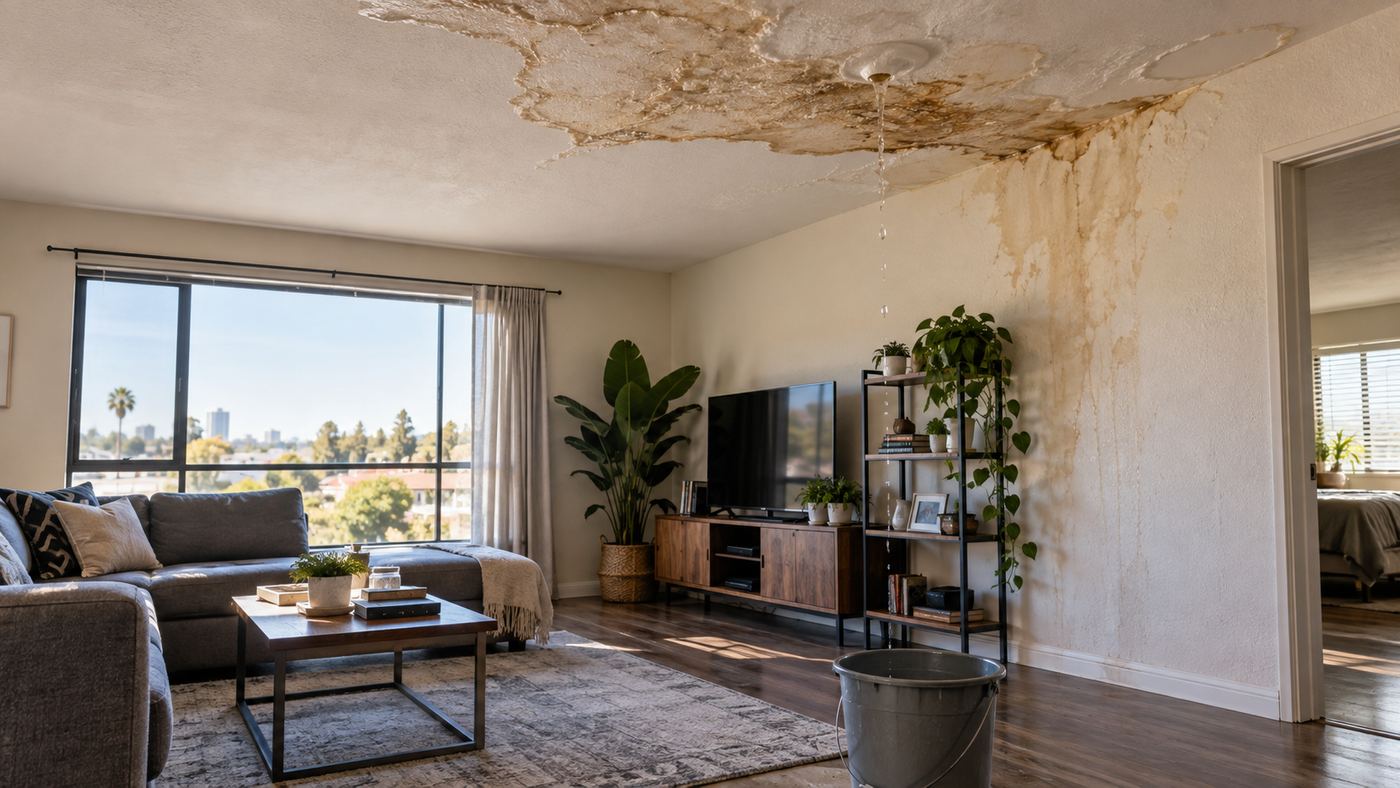
When an HOA board defers a waterproofing repair, delays a caulking replacement, or puts off a roofing issue until next year's budget, the decision is almost always framed as a cost-saving measure. The repair costs money now. Deferring it saves that money — at least for this budget cycle.
What rarely gets calculated is what the deferral actually costs.
Water damage to a California multifamily property is not a static condition. It is a progressive one. A failed balcony membrane that costs $8,000 to replace today becomes a structural repair that costs $45,000 when the framing beneath it has been saturating for two rainy seasons. A failed caulk joint at a window head that costs $200 to re-seal becomes a mold remediation and interior repair event that costs $15,000 when water has been entering the wall assembly for three years.
The math on deferred maintenance is almost never favorable — and for water-related damage specifically, the compounding effect of delay is among the most severe in all of exterior construction.
Here is what water damage to a California multifamily property actually costs — across every dimension that matters — and what the most effective and cost-efficient interventions look like before those costs are incurred.
How Water Damage Progresses: The Compounding Cost Curve
Understanding why deferred water damage is so expensive requires understanding how damage progresses once moisture enters a building assembly.
Stage One: Surface Penetration
Water enters the building envelope through a failed joint, a crack in the stucco, a compromised waterproofing membrane, or a deteriorated flashing. At this stage, the damage is limited to the point of entry and the immediate substrate. Repair costs are modest — a caulking replacement, a membrane patch, a stucco repair. The window for low-cost intervention is open.
Stage Two: Migration and Saturation
Water that is not stopped at the point of entry migrates through the wall assembly — traveling along structural members, saturating insulation, and moving horizontally within the cavity before finding a path to the interior or to another exterior surface. The area of damage expands well beyond the original entry point. Repair costs begin to increase as the scope of affected materials grows.
Stage Three: Biological Growth
Sustained moisture in a wall assembly creates the conditions for mold and mildew growth within the cavity. Once mold is established in a wall assembly, remediation requires more than drying — it requires physical removal of contaminated materials, treatment of affected structural components, and post-remediation testing to confirm clearance. This is where costs escalate dramatically.
Stage Four: Structural Deterioration
Extended water exposure causes wood framing to rot, metal connectors and fasteners to corrode, and structural connections to weaken. At balconies and elevated walkways — the elements governed by SB 326 and SB 721 — structural deterioration creates safety hazards that may require immediate removal from service, shoring, or emergency repair. At this stage, what began as a maintenance issue has become a structural rehabilitation project.
Stage Five: Interior Damage and Displacement
When water reaches the interior of occupied units — through ceiling staining, wall damage, flooring deterioration, or active leaking — the cost picture expands to include interior repairs, personal property damage claims, potential habitability issues, and in serious cases, the cost of temporarily relocating displaced residents.
The gap between Stage One and Stage Five costs is not incremental — it is exponential. And the timeline from Stage One to Stage Five in California's climate — with its concentrated winter rain events and then long dry periods that allow damage to normalize and go unnoticed — can be as short as two to three rainy seasons.
The Real Cost Categories of Water DamageStructural Repair and Reconstruction
Structural repair is consistently the largest cost category in water damage events on California multifamily properties. When wood framing, sheathing, ledger boards, rim joists, or structural connections have been damaged by sustained water exposure, the repair scope goes well beyond surface restoration.
A balcony deck where waterproofing failure has been left unaddressed for two to three seasons may require:
- Full removal of the deck surface and waterproofing system
- Removal of deteriorated decking material to access framing
- Replacement of rotted or structurally compromised joists, ledger boards, and sheathing
- Treatment or replacement of corroded metal connectors and fasteners
- Engineering review and inspection of the repaired assembly
- Rebuilding of the deck structure
- New waterproofing system installation
- New deck surface installation
- Stucco repair at the wall where the ledger connection was disturbed
- Painting and finishing
A repair scope of this complexity on a single balcony can range from $15,000 to $40,000 or more depending on the extent of structural damage — compared to $6,000 to $12,000 for a proactive waterproofing membrane replacement before structural damage occurs. Multiply that differential across multiple balconies in a community with systemic waterproofing failure and the financial impact becomes immediately apparent.
Mold Remediation
Mold remediation in a California multifamily building is a specialized, regulated process — and it is expensive. Once mold is identified within a wall assembly, the remediation scope typically includes:
- Professional mold assessment and air quality testing
- Containment of affected areas to prevent spore spread during remediation
- Physical removal of contaminated drywall, insulation, and in some cases structural wood
- HEPA vacuuming and treatment of affected structural surfaces
- Post-remediation clearance testing by an independent hygienist
- Reconstruction of removed wall and ceiling components
- Repainting and finishing of repaired areas
Mold remediation costs in California residential settings commonly range from $5,000 to $25,000 per affected unit depending on the extent of contamination — and that figure does not include the reconstruction and finishing costs that follow. In a multifamily building where water intrusion has affected multiple units, total mold-related costs can reach six figures.
Beyond the direct cost of remediation, mold in occupied residential units creates habitability concerns that trigger California's tenant protection statutes. A unit that is uninhabitable due to mold must be addressed promptly — and the association or property owner may be responsible for the cost of alternative housing for displaced residents during remediation.
Interior Repairs
Water damage that reaches the interior of occupied units generates interior repair costs that are entirely separate from the exterior remediation work. Typical interior repair costs following a water intrusion event include:
- Drywall replacement and finishing in affected walls and ceilings
- Insulation replacement
- Flooring replacement — carpet, hardwood, tile, or LVP depending on the unit
- Cabinet and millwork repair or replacement where water has caused warping or delamination
- Painting of repaired areas
- Fixture and appliance repair or replacement if affected
Interior repair costs following a significant water intrusion event commonly range from $8,000 to $30,000 per affected unit — and in severe cases where water has migrated extensively through a multi-story building, affecting multiple units across several floors, total interior repair costs can be substantially higher.
Personal Property Damage Claims
When water damages residents' personal property — furniture, electronics, clothing, artwork — residents may have claims against the association if the water intrusion resulted from the association's failure to maintain common area elements. California law imposes a duty of care on HOAs to maintain common area in a manner that does not cause damage to residents' separate interests or personal property.
Personal property claims following water intrusion events vary widely in value but commonly range from several thousand to tens of thousands of dollars per affected unit. When an association's failure to address a known waterproofing or roofing deficiency results in damage to multiple units, the aggregate personal property exposure can be significant.
Insurance Implications
Water damage claims affect an HOA's insurance profile in ways that extend well beyond the immediate claim payment. Multiple water damage claims — or a single large claim — can result in:
- Premium increases at renewal
- Coverage exclusions for specific perils or locations
- Higher deductibles
- Non-renewal of the master policy
An HOA that has experienced repeated water damage claims because of deferred exterior maintenance may find that its insurance costs increase substantially — or that coverage becomes difficult to obtain at any price. The long-term insurance cost impact of deferred maintenance is a real financial consequence that rarely appears in budget discussions but significantly affects the community's financial health.
Legal and Liability Costs
When water damage results in personal injury — a resident injured by a structurally compromised balcony, a slip and fall on a water-damaged walkway — the liability exposure can dwarf all of the repair and remediation costs combined. California premises liability law imposes a duty on property owners and HOAs to maintain property in a reasonably safe condition. A board that knew about a structural deficiency and failed to act on it is in a particularly difficult legal position.
Legal defense costs in premises liability cases — even cases that are ultimately resolved without a large judgment — commonly reach six figures. Settlements and judgments in cases involving serious injury can be in the millions. While these represent tail-risk scenarios rather than routine outcomes, they are scenarios that the proactive maintenance decisions of today are directly preventing or creating.
The Interventions That Prevent These Costs
The good news — and it is genuinely good news — is that the vast majority of water damage costs in California multifamily properties are preventable. The interventions required are neither exotic nor extraordinarily expensive. They are the standard components of a well-executed exterior maintenance program.
Comprehensive Waterproofing Maintenance
Balcony and deck waterproofing systems have defined service lives — typically ten to fifteen years for a quality membrane system in California's climate, shorter in high-UV or high-traffic applications. Replacing waterproofing membranes on a proactive cycle — before they fail — costs a fraction of what structural repair costs after they fail.
The math is straightforward: a proactive balcony waterproofing replacement at $8,000 prevents a structural rehabilitation at $35,000. Even accounting for the time value of money and the probability that not every deferred membrane will cause structural damage, the expected value of proactive maintenance is dramatically positive.
Caulking Programs
Comprehensive caulking replacement — at all windows, doors, control joints, and penetrations across the community — on a regular cycle is one of the highest-value maintenance investments an HOA can make. The cost of a community-wide caulking program is modest relative to the water intrusion it prevents.
A failed caulk joint at a window head costs pennies per linear foot to seal proactively. The water intrusion event it causes when left unaddressed costs thousands of dollars to remediate.
Roofing Maintenance and Inspection
Roofing failures — particularly at penetrations, flashings, and seams on flat roofs — are among the most common sources of significant water intrusion in multifamily properties. Annual roofing inspections that identify and address emerging issues before they become active leaks are a standard and cost-effective element of any exterior maintenance program.
A roofing flashing repair that costs $500 to address at the time of inspection becomes a water intrusion event affecting three floors of units — and the attendant interior repair, mold remediation, and personal property claims — when left unaddressed through two rainy seasons.
Regular Condition Assessments
The foundation of effective water damage prevention is knowing the actual condition of the building's exterior systems — not assuming, not relying on a reserve study projection, but having a qualified contractor assess the specific condition of waterproofing, caulking, roofing, and stucco on a regular cycle.
A condition assessment identifies the early warning signs of water intrusion risk before damage occurs — the blistering membrane, the failed caulk joint, the lifted flashing — and gives the board the information it needs to intervene at the lowest-cost point on the damage progression curve.
What the Numbers Actually Say
Let's put the math in concrete terms for a hypothetical 50-unit California HOA community with three buildings.
Proactive maintenance scenario:
- Annual roofing inspection and minor repairs: $2,500/year
- Caulking program every 5 years: $18,000
- Waterproofing membrane replacement, 12 balconies, proactive cycle: $96,000
- Total 10-year exterior water management cost: approximately $134,500
Deferred maintenance scenario:
- Two balconies requiring full structural rehabilitation: $70,000
- Mold remediation, 3 affected units: $45,000
- Interior repairs, 5 affected units: $75,000
- Personal property claims: $20,000
- Insurance premium increase over 3 years: $18,000
- Legal costs for one premises liability incident: $85,000
- Remaining waterproofing and roofing deferred: still to be addressed
- Total 10-year deferred maintenance cost: approximately $313,000+
The deferred scenario costs more than twice as much — and it doesn't include the costs that are hardest to quantify: the stress on board members, the damage to community relationships, the impact on property values, and the reputational harm to the community.
The Whitestone Commitment
At Whitestone Industries, we work with HOA boards and property managers across California to build and execute exterior maintenance programs that keep water out of buildings before it causes damage — not after.
We conduct thorough condition assessments. We identify waterproofing, caulking, and roofing vulnerabilities before they become intrusion events. We propose realistic, prioritized repair scopes with honest cost projections. And we execute the work with the quality and documentation that protects our clients long after the project is complete.
The communities we work with don't end up with $300,000 water damage bills. They end up with buildings that perform, budgets that are predictable, and boards that can tell their homeowners honestly that the community's assets are being protected.
Contact Whitestone Industries today to schedule a property condition assessment and take the first step toward a maintenance program that keeps water where it belongs — outside your buildings.
Whitestone Industries serves HOAs, multifamily property owners, and commercial properties throughout California with commercial and multi-family services, commercial roofing, SB 326 and SB 721 consulting and repairs, construction defect and destructive testing, and residential services. Call us at 888-567-2234 or visit wsindustries.com.