
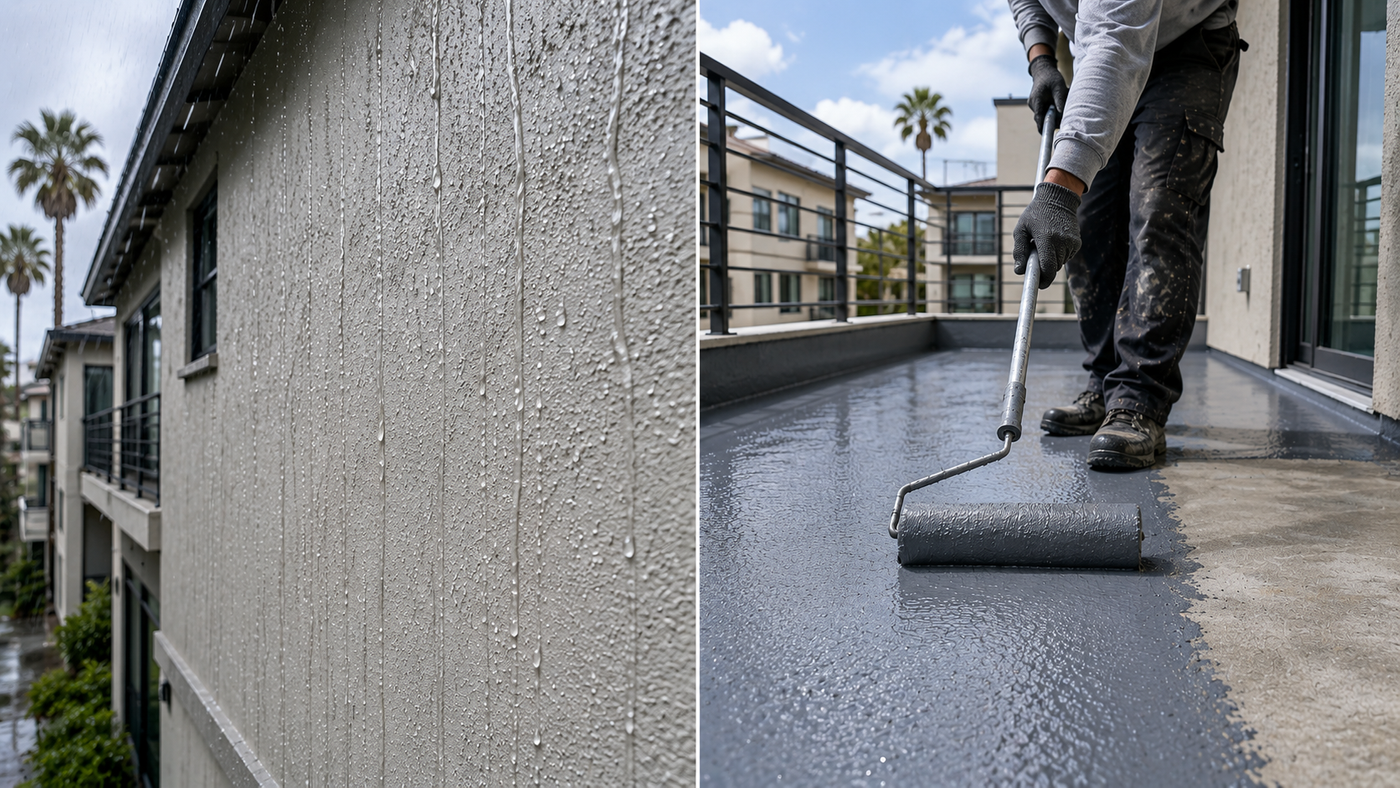
If you've ever reviewed a construction proposal, talked to a contractor about protecting your building's exterior, or scrolled through product descriptions at a paint supply store, you've likely seen both terms: waterproofing and water resistant.
They sound similar. They're often used interchangeably. And that confusion costs property owners — residential homeowners, HOA boards, and commercial property managers alike — real money every year.
Waterproofing and water resistance are not the same thing. Understanding the difference helps you ask better questions, evaluate contractor proposals more accurately, and make sure the right system gets specified for the right application on your property.
Water Resistance: What It Is and What It Isn't
A water-resistant material or coating slows the penetration of water. It creates a barrier that repels moisture under normal conditions — light rain, brief exposure, surface splash — but it is not designed to stop water under sustained pressure or prolonged exposure.
Think of water resistance as a jacket that keeps you dry in a light drizzle. It works well under the conditions it was designed for. Push it beyond those conditions — a heavy downpour, hours of exposure, direct water pressure — and moisture begins to work its way through.
Most standard exterior paints, including high-quality acrylic latex products, are water resistant. They protect the substrate beneath them from everyday moisture exposure, UV radiation, and the elements. They are a critical part of a well-maintained building envelope. But they are not waterproof.
The distinction matters most when a surface is subject to:
- Standing or pooling water
- Sustained hydrostatic pressure
- Direct water exposure for extended periods
- Submersion or near-submersion conditions
In these situations, a water-resistant coating is not sufficient. A true waterproofing system is required.
Waterproofing: What It Actually Means
Waterproofing means creating a continuous, impermeable barrier that prevents water from passing through a surface regardless of exposure duration or pressure. A properly waterproofed surface stops liquid water completely — not just slows it down.
True waterproofing is a system, not a single product. It typically involves multiple components working together: substrate preparation, a primer or bonding agent, one or more layers of waterproofing membrane, and in many cases a protective wear surface or topping coat. Each component plays a specific role, and the system is only as effective as its weakest element.
Waterproofing is required — not optional — in applications where water will be present for extended periods or where water intrusion would cause significant structural damage. Common applications on California residential and commercial properties include:
- Balconies and elevated decks — Surfaces that collect rain and are subject to foot traffic require a fully waterproofed membrane system, not just a water-resistant coating. This is directly relevant to SB 326 and SB 721 compliance requirements.
- Podium decks and parking structures — Horizontal concrete surfaces over occupied or conditioned space require continuous waterproofing to prevent water from migrating into the structure below.
- Planters and landscape features — Raised planters on rooftops or podium structures hold moisture continuously against the building structure and require waterproofing systems designed for that sustained exposure.
- Below-grade walls and foundations — Subsurface walls that are in contact with soil and groundwater require waterproofing, not just dampproofing or water-resistant coatings.
- Shower pans and wet areas — Interior wet areas require waterproofing beneath tile and finish surfaces to protect the structure from constant moisture exposure.
- Roofing systems — Flat and low-slope roofs require waterproofing membrane systems capable of handling standing water and sustained exposure.
Why the Distinction Matters for California Property OwnersStucco Is Water Resistant — Not Waterproof
This is one of the most commonly misunderstood points in California exterior construction. Stucco is a durable and effective exterior finish, and when properly coated and maintained it provides meaningful protection against moisture. But stucco is not waterproof.
Stucco is a cementitious material — it is permeable. Water that penetrates through cracks, gaps, or a failed coating can migrate through the stucco and into the wall assembly behind it. The weather-resistant barrier (WRB) behind the stucco is the primary line of defense against water reaching the framing — but once that barrier is compromised, water intrusion can cause dry rot, mold, and structural damage.
Elastomeric coatings applied over stucco provide significantly better moisture resistance than standard paint, and their crack-bridging capability reduces the risk of water entry through hairline cracks. But even a high-quality elastomeric coating is a water-resistant system, not a true waterproofing membrane.
Where stucco walls transition to horizontal surfaces — balcony decks, window sills, ledger connections — those horizontal elements require true waterproofing, not just a good exterior coating.
Balconies Require Waterproofing — Full Stop
If your property has balconies, elevated walkways, or stairway landings, those surfaces need waterproofing systems — not paint, not water-resistant deck coatings, and not a thin membrane product applied without proper substrate prep.
California's SB 326 and SB 721 inspection requirements have brought significant attention to the condition of elevated exterior elements in multifamily properties. One of the most common findings in these inspections is failed or inadequate waterproofing on balcony and deck surfaces — and the consequences range from costly repairs to safety hazards that require the surface to be immediately taken out of service.
A true balcony waterproofing system includes proper substrate preparation, a reinforced membrane applied to manufacturer-specified thickness, flashing integration at all transitions and terminations, and a protective wear surface capable of handling foot traffic. Anything less is a temporary fix, not a solution.
"Waterproof Paint" Is Usually Water Resistant
This is a common source of confusion in the residential market. Many products marketed as "waterproof paint" or "waterproof masonry coating" are, in fact, water-resistant products — they perform well under normal conditions but are not designed for the sustained hydrostatic pressure or prolonged exposure that true waterproofing systems handle.
This doesn't mean these products aren't valuable — a high-quality water-resistant masonry coating is a legitimate and effective product for above-grade vertical surfaces. But applying a "waterproof paint" to a balcony deck, a podium surface, or any horizontal element that will collect and hold water is not the same as waterproofing that surface.
Reading product data sheets and understanding what a product is actually rated for — rather than relying on marketing language — is part of what separates a qualified contractor from one who is simply applying whatever product is on the shelf.
How to Know Which System Your Property Needs
The right system depends on the specific application, the level of water exposure, and the consequences of water intrusion if the system fails. Here's a practical framework:
Water-resistant coatings are appropriate for:
- Vertical exterior walls (stucco, concrete, masonry) above grade
- Surfaces exposed to rain and normal weather but not standing water
- Applications where the primary goal is UV protection, moisture resistance, and aesthetics
True waterproofing systems are required for:
- Any horizontal surface that collects water — balconies, decks, walkways, podiums
- Surfaces subject to sustained hydrostatic pressure — below-grade walls, foundations, retaining walls
- Roofing membranes on flat or low-slope roofs
- Any surface where water intrusion would directly impact occupied or conditioned space below
When in doubt, waterproof. The cost difference between a water-resistant coating and a proper waterproofing system is real — but it is never as large as the cost of repairing water damage, replacing structural framing, or remediating mold after a waterproofing failure.
The Importance of System Thinking
One of the most important concepts in waterproofing is that a system is only as effective as its weakest point. A perfectly installed waterproofing membrane that terminates improperly at a drain, a wall transition, or a door threshold will fail at that termination — and water will find it.
This is why waterproofing should always be approached as a system — with careful attention to:
Substrate preparation. Cracks, voids, and surface contamination must be addressed before any membrane is applied. A membrane applied over a compromised substrate will fail prematurely regardless of product quality.
Detailing at transitions. The connections between the waterproofing membrane and adjacent materials — drains, walls, thresholds, penetrations — are the most vulnerable points in any system. These details require careful execution and often specialized flashing or termination products.
Compatibility between components. Primers, membranes, topcoats, and flashing materials must be compatible with each other and with the substrate. Mixing products from different systems or manufacturers without verifying compatibility is a common source of premature failure.
Proper thickness and coverage. Waterproofing membranes must be applied at the thickness specified by the manufacturer to achieve their rated performance. Thin spots, holidays, and areas of insufficient coverage create vulnerabilities that water will eventually find.
What This Means When You're Reviewing a Proposal
When you receive a proposal for exterior work — whether for a residential repaint, a balcony repair, or a commercial roofing project — the language used to describe the waterproofing scope matters.
Watch for vague terms like "seal the deck" or "apply waterproof coating" without specific product names, application rates, or system descriptions. A qualified contractor should be able to tell you exactly what system they are proposing, what products are being used, and what the installed system is rated to handle.
If a proposal for balcony or deck work doesn't specifically describe a membrane waterproofing system — including surface prep, membrane product and thickness, and termination details — it may not be proposing true waterproofing at all.
The Whitestone Approach
At Whitestone Industries, we bring the same level of specificity to waterproofing scope as we do to every other aspect of our proposals. Whether we're specifying an elastomeric coating for a stucco exterior, a reinforced membrane system for a balcony deck, or a roofing membrane for a commercial flat roof, we use the right system for the right application — and we explain the difference to our clients so they can make informed decisions.
We don't apply paint where waterproofing is needed. And we don't oversell waterproofing systems where a high-quality water-resistant coating is the appropriate and cost-effective solution.
If you have questions about what your property actually needs — or you've received proposals that use these terms in ways that aren't entirely clear — we're happy to walk you through it.
Contact Whitestone Industries today to schedule a property assessment and get a clear, honest recommendation for your exterior waterproofing and coating needs.
Whitestone Industries serves HOAs, multifamily property owners, and commercial properties throughout California with commercial and multi-family services, commercial roofing, SB 326 and SB 721 inspections and consulting, construction defect and destructive testing, and residential services. Call us at 888-567-2234 or visit wsindustries.com.