When most people think about pressure washing, they think about curb appeal. A grimy driveway getting blasted clean. A fence going from gray and weathered back to its original color. The satisfying before-and-after of a building that looks like it just had a bath.
And pressure washing does make things look better. But on a professional exterior construction project — a repaint, a waterproofing rehabilitation, a stucco repair, a deck coating — pressure washing isn't about appearances. It's about adhesion. It's about performance. It's about making sure that every dollar spent on materials and labor after the washing is protected by a clean, sound surface that will actually hold what's applied to it.
Done correctly, pressure washing is one of the most important steps in any exterior project. Done incorrectly — or skipped entirely — it is one of the most common reasons exterior coatings, membranes, and sealants fail prematurely.
Here's what property owners, HOA boards, and property managers need to understand about why pressure washing matters and what it actually involves when it's done right.
Why Surface Cleanliness Is a Technical Requirement, Not a Preference
Every coating, membrane, and sealant product used in exterior construction has one fundamental requirement in common: it must bond to the substrate beneath it. That bond is the foundation of everything — the coating's ability to resist moisture, withstand UV exposure, bridge minor cracks, and last its full intended service life.
Contamination breaks that bond.
Dirt, dust, mold, mildew, efflorescence, chalking paint, oil, bird droppings, atmospheric deposits, and construction residue all act as barriers between the coating and the substrate. A primer or paint applied over a contaminated surface isn't bonding to the stucco, concrete, or wood beneath it — it's bonding to the contaminant layer. And that contaminant layer will eventually release, taking the coating with it.
This is why premature paint failure — peeling, bubbling, loss of adhesion — so often traces back to inadequate surface preparation rather than a problem with the paint product itself. The coating performed exactly as designed. It just wasn't given a clean surface to bond to.
Pressure washing removes the contamination layer and exposes the actual substrate so that primers, coatings, and membranes can form the direct bond they were engineered to create. It is not a preliminary nicety — it is a technical prerequisite.
What Proper Pressure Washing Actually Involves
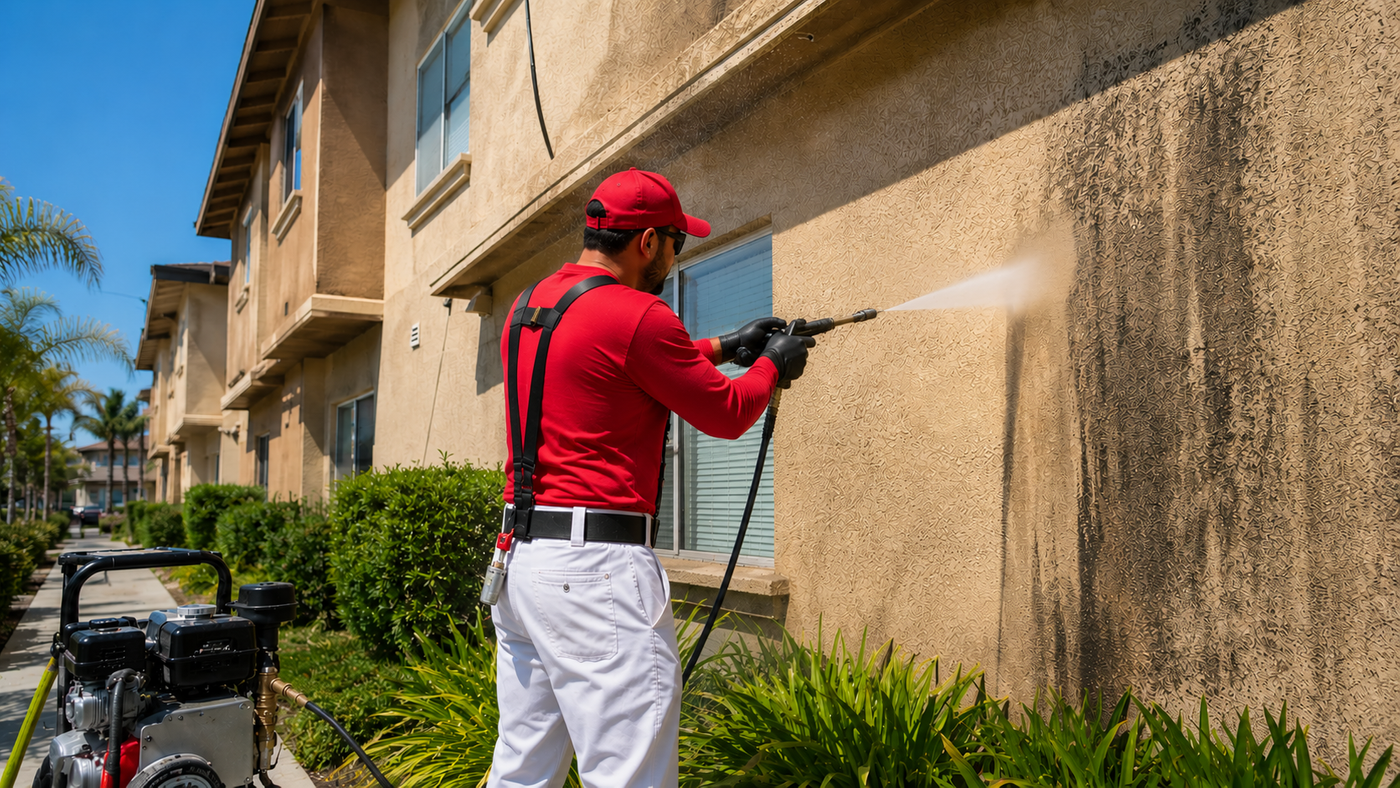
Professional pressure washing on an exterior construction project is not the same as running a consumer pressure washer over a surface until it looks clean. It involves careful attention to equipment selection, pressure settings, detergent use, technique, and sequencing — all of which affect both the effectiveness of the cleaning and the integrity of the surfaces being cleaned.
Equipment and Pressure Selection
Different surfaces require different pressure levels. Applying too much pressure to the wrong surface can damage stucco, erode mortar joints, force water into wall assemblies, or create texture irregularities that show through paint. Applying too little pressure leaves contamination behind.
Professional contractors use commercial-grade equipment capable of delivering the appropriate pressure and flow rate for the surface being cleaned — and they adjust settings based on what they encounter. Stucco, concrete, wood, and composite surfaces all have different thresholds and require different approaches.
Detergent and Chemical Treatment
For surfaces with biological growth — mold, mildew, algae, or lichen — water pressure alone is not sufficient. These organisms have root structures that penetrate the surface and will regrow quickly if not chemically treated before or during washing.
Professional pressure washing on contaminated surfaces typically involves the application of a biocidal cleaning solution — often a diluted bleach-based or specialty mildewcide product — allowed to dwell on the surface for a defined period before rinsing. This kills the biological growth at the root level rather than simply removing visible surface discoloration.
Skipping chemical treatment on a surface with active biological growth is a setup for premature coating failure. Mold and mildew that remain alive beneath a fresh coat of paint will continue to grow, eventually pushing through the coating and causing adhesion failure.
Technique and Sequencing
Effective pressure washing follows a defined technique — working from top to bottom to allow contaminants to rinse downward, maintaining consistent distance and angle to avoid surface damage, overlapping passes to ensure complete coverage, and paying particular attention to areas where contamination concentrates: overhangs, north-facing elevations, areas near planters and irrigation, and low-traffic surfaces that accumulate biological growth over time.
On a multi-building community, sequencing matters as well. Buildings should be washed in an order that allows adequate drying time before coating work begins — typically a minimum of 24 to 48 hours depending on temperature, humidity, and surface porosity. Applying paint or coatings to a surface that hasn't fully dried after washing traps moisture beneath the coating, which can cause blistering, adhesion failure, and accelerated deterioration.
Protecting Adjacent Surfaces and Landscaping
Professional pressure washing includes protecting surfaces and plantings that should not be exposed to high-pressure water or cleaning chemicals. Windows, light fixtures, electrical components, HVAC equipment, and landscaping adjacent to work areas all require consideration. A thorough contractor masks or covers sensitive areas before washing begins and rinses landscaping before and after chemical treatments to minimize impact.
What Can Go Wrong When Pressure Washing Is Skipped or Done Poorly
The consequences of inadequate pressure washing show up over time, not immediately — which is part of why it's easy for a cost-cutting contractor to skip it and collect payment before the failure becomes visible. But the failure always comes.
Premature paint adhesion failure. Paint applied over a dirty or contaminated surface will begin to peel, flake, or bubble as the contaminant layer beneath it releases. This can happen within months on a heavily contaminated surface and will certainly happen well before the coating reaches its intended service life.
Mold and mildew bleed-through. Biological growth that isn't properly treated before painting will continue to grow beneath the new coating, eventually appearing as dark staining or bubbling through the finish surface. In severe cases, the coating must be stripped and the surface retreated before repainting.
Waterproofing membrane failure. A waterproofing membrane applied over a contaminated concrete or wood substrate will delaminate as the bond between membrane and substrate fails. On a balcony or deck, membrane delamination means water is no longer being kept out — and the structural consequences can be significant.
Shortened coating service life. Even in cases where adhesion failure isn't dramatic or sudden, coatings applied over inadequately prepared surfaces degrade faster and protect less effectively than coatings applied over properly prepared substrates. A paint job that should last eight to ten years may look tired and begin to fail in four or five.
Voided manufacturer warranties. Most premium paint and coating manufacturers specify minimum surface preparation requirements as a condition of their product warranty. If a warranty claim is submitted and investigation reveals that surfaces were not properly prepared — including adequately washed — the manufacturer may deny the claim.
Pressure Washing as Part of a Complete Preparation Sequence
It's important to understand that pressure washing, while critical, is one step in a complete surface preparation sequence — not the entirety of prep work. On a professional exterior project, washing is followed by:
Inspection of the washed surface. Once surfaces are clean and dry, conditions that were obscured by dirt and biological growth become visible — cracks, delaminating stucco, soft spots in wood, failed caulking, areas of moisture staining. A thorough post-wash inspection often reveals conditions that weren't apparent before washing and refines the repair scope.
Repair of identified deficiencies. Stucco cracks, damaged areas, deteriorated wood, and compromised surfaces identified after washing are repaired before coating work begins.
Caulking replacement. Existing caulking that has hardened, cracked, or lost adhesion is removed and replaced with fresh sealant appropriate for the substrate and application.
Priming. Bare or repaired surfaces, areas where the existing coating has been removed, and surfaces transitioning between materials typically require priming before finish coats are applied. Primer promotes adhesion, seals porous surfaces, and in some cases provides additional corrosion resistance or stain blocking.
Each of these steps builds on the foundation that proper pressure washing establishes. Skip or rush the washing, and every subsequent step is compromised.
Questions to Ask Your Contractor About Pressure Washing
When reviewing a proposal for an exterior painting, waterproofing, or coating project, the treatment of surface preparation — including pressure washing — tells you a lot about the contractor's standards. Here are the questions worth asking:
What pressure and equipment will you use, and how do you adjust for different surface types? A knowledgeable contractor should be able to speak specifically to this.
How will you treat surfaces with mold or mildew growth? If the answer doesn't include chemical treatment and dwell time, that's a gap worth addressing.
How long will you allow surfaces to dry before applying coatings? The answer should reflect an understanding of how moisture affects coating adhesion.
Is pressure washing included in the proposal price, or is it a separate line item? Either structure is fine, but you should know what you're paying for and confirm it's not being omitted entirely.
What happens if washing reveals conditions — cracks, damage, failed caulking — that weren't visible before? A good contractor has a process for this and will discuss it with you before the project starts.
The Whitestone Standard for Surface Preparation
At Whitestone Industries, surface preparation — including professional pressure washing — is never an optional add-on or a step we rush through to get to the visible work faster. It is the foundation of every exterior project we perform, and we treat it accordingly.
We use commercial-grade equipment, specify chemical treatments appropriate for each surface condition, allow proper drying time before coating work begins, and conduct a thorough post-wash inspection before any repair or coating work starts. When washing reveals conditions that need to be addressed, we discuss them with our clients before proceeding — not after.
Because we know that a coating applied over a properly prepared surface will perform as specified, protect the building as intended, and last its full service life. And that's what our clients are actually paying for.
Contact Whitestone Industries today to schedule a consultation for your next exterior project — and experience what proper surface preparation looks like from start to finish.
Whitestone Industries serves HOAs, multifamily property owners, and commercial properties throughout California with commercial and multi-family services, commercial roofing, SB 326 and SB 721 consulting and repairs, construction defect and destructive testing, and residential services. Call us at 888-567-2234 or visit wsindustries.com.