
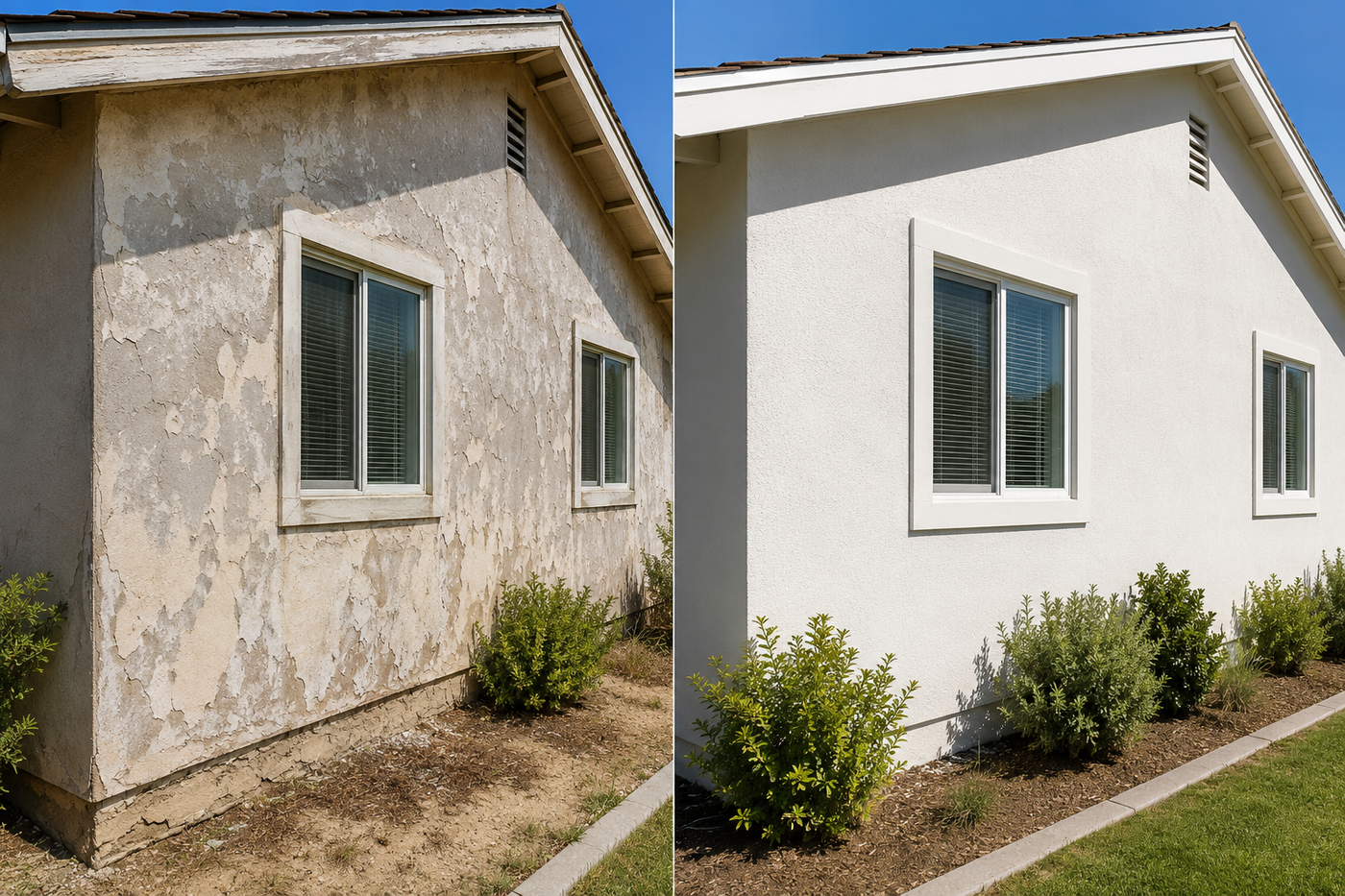
One of the most common questions homeowners ask when they start noticing their exterior paint looking a little tired is: do I really need to repaint the whole house, or can I just touch up the problem areas?
It's a fair question — and the honest answer is that it depends. Sometimes targeted touch-up work is a completely legitimate short-term solution that buys you meaningful time before a full repaint is warranted. Other times, touch-up is exactly the wrong approach — a way of spending money on a cosmetic fix while the underlying condition continues to deteriorate beneath the surface.
Knowing the difference saves you money, protects your home, and helps you make a confident decision when a contractor is standing in your driveway giving you options.
Here's how to think through it.
What Touch-Up Actually Is — and What It Isn't
Touch-up painting means addressing specific areas of coating failure — spots where paint has peeled, chipped, or worn away — without repainting the entire surface. It's spot treatment: scrape the loose paint, prime the bare area, apply a finish coat to match the existing color, and move on.
Done correctly and at the right time, touch-up is a legitimate maintenance practice. It stops bare substrate from being exposed to moisture and UV, slows the progression of coating failure at specific locations, and can extend the life of an overall paint job that is otherwise in reasonable condition.
But touch-up has real limitations that homeowners need to understand before committing to it as a strategy:
Touch-up doesn't address the underlying cause of failure. If paint is peeling because of moisture intrusion, inadequate original prep, or failed caulking, touching up the peeled area without addressing the root cause means the same spot — or the area around it — will fail again.
Touch-up rarely matches perfectly. Exterior paint fades and weathers over time, and even the same paint mixed to the same formula will look noticeably different on a weathered surface. On a small, discreet area, this may not matter much. On a large, visible wall section, touch-up patches can look worse than the original problem.
Touch-up is not a substitute for a coating that has reached the end of its service life. A paint job that is chalking, fading uniformly, or losing adhesion across large areas is telling you the coating system is exhausted — and touching up isolated spots doesn't restore the protective capability of the overall coating.
Signs That Touch-Up Is a Reasonable Approach
Touch-up makes sense when the overall condition of the exterior coating is sound and the failure is truly isolated — limited to specific, identifiable locations with a clear cause that can be addressed.
Impact or Mechanical Damage
If your paint is in otherwise good condition but a specific area has been damaged by impact — a ladder leaned against the wall, a gate that swings and hits the stucco, a sprinkler head that's been hitting the fascia — touch-up is appropriate. The coating system is sound; the damage is localized and mechanical.
Address the cause of the damage first, then touch up the affected area with proper prep and a color-matched finish coat.
Recent Repair Work
If stucco has been patched, a crack has been repaired, or wood trim has been replaced, those repaired areas will need to be primed and painted to match the surrounding surface. If the surrounding paint is in good overall condition, touch-up of the repaired areas is the right approach — not a full repaint triggered by the repair.
Minor Trim or Accent Failures
If your body paint is in good condition but specific trim elements — fascia boards, window surrounds, a particular door frame — are showing isolated failure, touching up or repainting just those elements is a legitimate option. Trim and accent colors often need attention on a different cycle than body paint because they are applied to different substrates with different exposure conditions.
Two to Three Years Before a Planned Full Repaint
If your home is approaching the end of its paint cycle — say, six to eight years into a paint job that typically lasts eight to ten — and you have a few spots of peeling or failure, touching up those spots to protect the substrate while you plan and budget for a full repaint in the next year or two is a reasonable bridge strategy. You're not trying to avoid the repaint; you're managing the condition of the home until the repaint happens.
Signs That a Full Repaint Is the Right AnswerWidespread Chalking
Run your hand along an exterior wall. If you pull away a white, powdery residue — that's chalk, the result of UV degradation breaking down the paint binder. A moderate amount of chalking indicates the coating is aging but may have some life left. Heavy chalking across most surfaces means the coating has lost most of its protective capability and is no longer bonded effectively to the substrate.
You cannot touch-up over chalking. New paint applied over a heavily chalked surface will bond to the chalk rather than the substrate and will fail quickly. A chalked surface requires thorough cleaning and often a bonding primer before new paint can be successfully applied — which means you're already doing most of the prep work for a full repaint.
Widespread Peeling or Flaking
If peeling is isolated to one or two spots with a clear mechanical cause, touch-up may be appropriate. If peeling is occurring across multiple elevations, in patterns that suggest systemic failure — at window frames throughout the house, along the roofline consistently, at the base of walls across multiple walls — the coating system has failed broadly and touch-up will not solve the problem.
Widespread peeling tells you either the original preparation was inadequate, the product has reached the end of its service life, or there is a moisture condition driving failure from behind. All three of these root causes require a comprehensive approach — not spot treatment.
Fading and Color Uniformity Loss
Exterior paint fades as UV radiation breaks down the pigments in the coating. On south and west-facing elevations in California's intense sun, this fading can be significant over seven to ten years. When fading has progressed to the point where the color is noticeably uneven across the surface — or where it has faded so dramatically that the appearance of the home has changed substantially — touch-up cannot restore uniformity. Only a full repaint will get you back to a consistent, intentional appearance.
Hairline Cracking Across Large Surface Areas
A network of fine hairline cracks across stucco — sometimes called alligatoring or crazing — indicates that the coating has lost its flexibility and can no longer accommodate the thermal movement of the substrate beneath it. At this stage, the coating is actively cracking with every temperature cycle, and each crack is a potential water entry point.
Touch-up of individual cracks in this condition is a losing battle. The underlying coating will continue to crack in new locations as fast as the touched-up areas are addressed. The right solution is a full repaint with proper surface preparation — and depending on the severity, an elastomeric coating system that can bridge and seal the crack network and restore flexibility to the surface.
When the Paint Is More Than Ten Years Old
Most high-quality exterior paint systems have an effective service life of seven to ten years in California's climate — sometimes longer with optimal conditions and excellent original prep, sometimes shorter on south and west-facing elevations with heavy UV exposure. Once a paint job is approaching or past the ten-year mark, touch-up is rarely the right answer regardless of how the surface looks.
At this age, the coating's UV resistance is exhausted, its flexibility is compromised, and its adhesion to the substrate has been progressively weakened by years of thermal cycling. A coating in this condition can fail rapidly and broadly — often triggered by the first significant rain after a long dry summer — and touch-up work performed just before that failure will be wasted.
When Caulking Is Failing Throughout the Property
If you're seeing caulking failure at windows, doors, and joints throughout the property — not just in one or two isolated locations — that's a signal that a comprehensive maintenance scope is needed rather than spot treatment. Caulking replacement should be integrated with an exterior repaint so the new caulking is properly incorporated into the coating system rather than applied over new paint.
Doing caulking replacement without a repaint, or a repaint without caulking replacement, is treating half the problem. If the overall condition of the property warrants both, they should be done together.
The Real Cost Comparison
Homeowners often gravitate toward touch-up because the upfront cost is lower. And it is — in the short term. But the total cost calculation over a multi-year horizon is more complicated.
Consider a home that needs a full repaint but opts for touch-up instead:
- Year one: Touch-up cost is modest. The problem areas are addressed temporarily.
- Year two: New areas of failure appear because the underlying coating is exhausted. More touch-up is needed. The touch-up patches from year one are already fading differently from the surrounding surface.
- Year three: The coating has failed broadly enough that a full repaint is now unavoidable — but now the preparation scope is larger because the coating has deteriorated further and substrate damage may have occurred from moisture intrusion through failed areas.
The homeowner has spent money on two years of touch-up work and still ends up doing the full repaint — at higher cost because of the additional prep required. The total spend exceeds what a full repaint in year one would have cost, and the home's exterior went through two additional years of deterioration in the meantime.
This is the math that makes proactive, timely repainting a better financial decision than reactive touch-up for a coating that has genuinely reached the end of its service life.
How to Get a Straight Answer
If you're not sure which approach is right for your home, the most reliable way to find out is to have a qualified exterior contractor assess the actual condition of your coating — not just look at the obvious problem spots, but evaluate the overall adhesion, flexibility, and protective capability of the existing coating system.
A contractor who will tell you honestly when touch-up is the right answer — rather than always recommending a full repaint — is a contractor worth trusting. At Whitestone Industries, we give homeowners a straight assessment of where their exterior actually stands and what the right approach is for their specific situation, their budget, and their timeline.
Sometimes that's a full repaint. Sometimes it's targeted touch-up with a clear plan for a full repaint in the next year or two. And sometimes it's a phased approach that addresses the most critical surfaces now and plans the balance for a subsequent phase.
What it's never is a recommendation designed to maximize the size of the job rather than serve the homeowner's actual interests.
Contact Whitestone Industries today to schedule a free exterior assessment and get an honest answer about whether your home needs a full repaint, a touch-up, or something in between.
Whitestone Industries serves HOAs, multifamily property owners, and commercial properties throughout California with commercial and multi-family services, commercial roofing, SB 326 and SB 721 consulting and repairs, construction defect and destructive testing, and residential services. Call us at 888-567-2234 or visit wsindustries.com.