
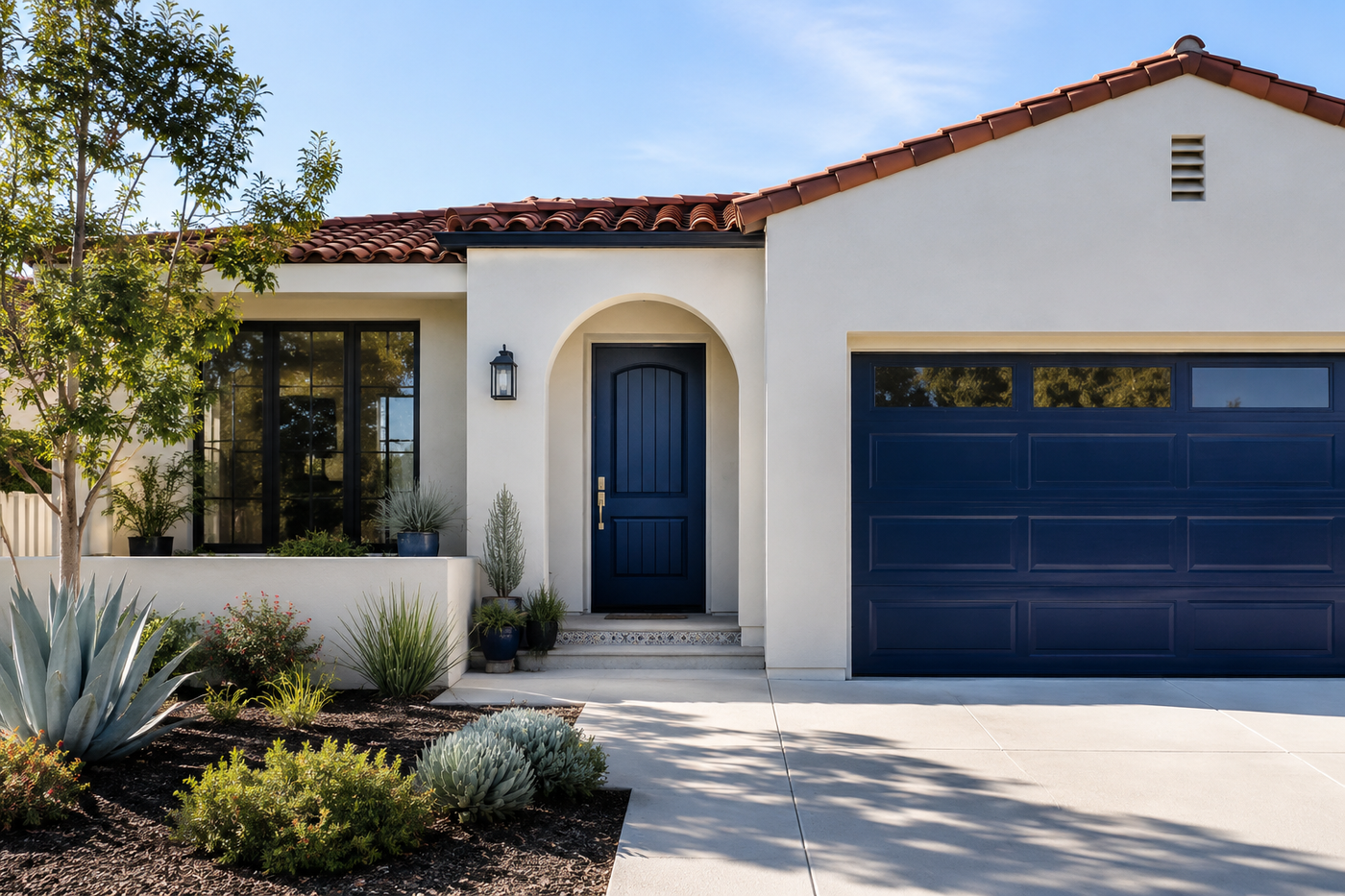
If you've been thinking about refreshing your home's exterior but aren't ready for a full repaint, there's one upgrade that delivers more visual impact per dollar than almost anything else you can do: painting your front door and garage door.
These two elements anchor the front of your home. They're the first thing visitors see, the focal point of every photo taken from the street, and the details that signal whether a home is well-maintained or starting to show its age. A faded, chalking garage door and a worn front door can make an otherwise well-kept home look tired. Fresh, intentional color on both can make the entire property feel updated — even if nothing else has changed.
And the best part? Compared to a full exterior repaint, painting your doors is fast, affordable, and delivers results you can see from the street the same day the work is done.
Here's what California homeowners need to know about door painting — from surface prep and product selection to color choices and when to call a professional.
Why Your Doors Take More Abuse Than the Rest of Your Exterior
Before getting into how to refresh your doors, it helps to understand why they need attention in the first place — often well before the rest of the house is ready for a repaint.
Garage Doors
Garage doors face west or south on many California homes, putting them in the direct path of the afternoon sun for hours every day. In the Central Valley and inland Southern California, that means surface temperatures that can exceed 150°F on a hot summer day — punishing conditions for any exterior coating.
The constant thermal expansion and contraction that results from these temperature swings causes paint to crack, peel, and lose adhesion faster than on any other surface on the home. Add in the mechanical movement of the door — opening and closing dozens of times a week — and you have a recipe for a coating that ages quickly regardless of how well it was applied.
Most garage doors are also steel or aluminum, which requires specific primers and coatings to prevent rust and ensure adhesion. A standard exterior latex applied directly to bare metal without proper preparation won't last — and on a door that gets this much sun and use, even a properly applied coating needs attention every five to seven years.
Front Doors
Front doors take abuse from a different direction. They're touched constantly, exposed to direct sun on many homes, and subject to impact from packages, foot traffic, and the elements. Wood doors expand and contract with humidity and temperature changes, which stresses the paint film at edges and panel joints. Steel and fiberglass doors are more dimensionally stable but still require proper coating systems to hold up over time.
The finish on a front door also matters more aesthetically than almost any other surface on the home — it's seen up close, every day, by everyone who enters. Fading, chipping, or peeling on a front door is impossible to ignore in a way that similar deterioration on a second-story wall panel simply isn't.
Surface Preparation: Where Door Painting Projects Succeed or Fail
As with any exterior coating project, the quality of the finished result on a door painting project is determined almost entirely by the quality of the preparation. A beautiful color applied over a poorly prepared surface will look great for a few months and disappoint you within a year.
Garage Door Preparation
A professional garage door repaint starts with a thorough cleaning — pressure washing or hand washing with a degreasing solution to remove dirt, oxidation, and any chalking from the existing coating. On steel doors, any areas of rust must be treated with a rust converter or wire-brushed to bare metal before priming.
Existing paint that has lost adhesion — bubbling, peeling, or flaking areas — must be scraped and feathered so the new coating has a smooth, sound surface to bond to. Glossy existing surfaces should be lightly sanded or etched to promote adhesion of the new primer and topcoat.
Panel joints and seams on sectional garage doors should be inspected and caulked as needed to prevent moisture entry. Hardware — handles, hinges, and lock sets — should be masked or removed before painting begins.
Front Door Preparation
Wood front doors require the most preparation attention. Any areas of peeling or failing finish must be stripped back to sound material. Wood that has checked, cracked, or shows signs of moisture damage should be repaired with an appropriate wood filler or epoxy product before finishing. The entire surface should be sanded smooth before priming, with particular attention to panel edges and molding profiles where paint tends to build up unevenly over successive coats.
Steel and fiberglass doors are more forgiving dimensionally but still require thorough cleaning, light sanding of glossy surfaces, and appropriate priming before topcoats are applied.
On any front door, the frame, threshold, and adjacent trim should be assessed at the same time. Repainting a door while leaving weathered, peeling trim around it defeats much of the visual benefit — and a professional contractor will typically include the door surround in the scope to ensure a cohesive finished result.
Product Selection: Using the Right Coating for Each Surface
Not all exterior paint is appropriate for doors, and using the wrong product is a common reason door paint jobs fail prematurely.
For Garage Doors
Steel and aluminum garage doors require a primer specifically formulated for metal substrates — typically a rust-inhibiting primer that promotes adhesion and prevents oxidation. Over the primer, a high-quality exterior acrylic latex or alkyd-modified acrylic in a satin or semi-gloss finish provides durability, UV resistance, and the slight sheen that shows well on a large flat surface.
Avoid flat finishes on garage doors — they show every imperfection, are difficult to clean, and don't hold up as well to the thermal stress these surfaces experience. A satin or semi-gloss finish is more forgiving, easier to maintain, and holds up better over time.
For Front Doors
Front doors are one of the few places on a home's exterior where a higher sheen — semi-gloss or even gloss — is appropriate and desirable. A gloss or semi-gloss finish on a front door reads as intentional and polished, reflects light attractively, and is durable and easy to wipe clean.
For wood doors, an exterior alkyd or alkyd-modified acrylic provides excellent flow and leveling — meaning brush marks smooth out beautifully — and cures to a hard, durable film that holds up well to the mechanical abuse a front door takes. For steel and fiberglass doors, a high-quality exterior acrylic in a semi-gloss or gloss finish is appropriate and durable.
On both door types, two finish coats over a properly primed surface deliver better coverage, color depth, and durability than a single heavy coat.
Color Selection: Making a Statement That Works With Your Home
This is where the fun begins. Door color is one of the few places on a home's exterior where a bold, intentional choice reads as design-forward rather than out of place — and the options are far broader than most homeowners realize.
Garage Doors
Most homes look best with a garage door that either matches the main body color of the house or coordinates closely with it. A garage door that blends into the facade creates a clean, cohesive look and lets other elements — landscaping, the front door, architectural details — take visual priority.
That said, homes with certain architectural styles — craftsman, farmhouse, contemporary — can carry a garage door in a contrasting color, particularly in charcoal, black, or deep navy, that creates a striking and intentional statement. If you're considering a contrasting garage door color, it generally works best when it coordinates with another accent element on the home — the front door, shutters, or window trim.
In HOA communities, garage door color is typically governed by the association's architectural guidelines. Always confirm approved colors before committing to a selection — most associations require a formal approval submission for color changes, even on doors.
Front Doors
Front door color is where personality lives. A front door in a rich, saturated color — deep red, navy, forest green, charcoal, black, or even a warm mustard or terracotta — makes an immediate and confident statement while remaining tasteful when the color is chosen to complement the home's overall palette.
Classic choices that work on almost any California home:
- Black or charcoal — sophisticated, timeless, works with virtually any body color
- Deep navy — warm and welcoming, particularly strong against tan, gray, or white stucco
- Rich red — traditional and energetic, especially effective on homes with warm-toned stucco or brick
- Sage or forest green — organic and grounded, works beautifully with California landscaping
- Bold yellow or terracotta — unexpectedly warm and welcoming in the right palette
As with garage doors, HOA communities typically regulate front door colors. Check your CC&Rs and submit for architectural approval before purchasing paint.
When to DIY and When to Hire a Professional
Door painting is one of the more approachable exterior painting projects for a motivated homeowner — the surfaces are manageable in size, the preparation is relatively straightforward, and the results are immediately visible and gratifying.
That said, there are situations where hiring a professional makes more sense:
When the existing coating is in poor condition. Extensive peeling, rust on a steel door, or a wood door with significant checking or moisture damage all require more involved preparation work that benefits from professional tools and experience.
When you want a truly flawless finish. Achieving a smooth, brush-mark-free finish on a front door — particularly in a high-gloss product — requires careful product selection, proper application technique, and ideally spraying rather than brushing for the smoothest result. A professional painter with the right equipment can deliver a factory-like finish that's difficult to replicate with a brush and roller.
When the project includes more than just the doors. If you're refreshing the doors as part of a broader exterior update — repainting trim, touching up stucco, refreshing window surrounds — the efficiency and quality of having a single professional crew handle the full scope is hard to beat.
When you're in an HOA community. Many associations have specific requirements around approved contractors, surface preparation standards, and color approval processes. Working with a licensed professional who is familiar with HOA project requirements avoids compliance issues and ensures the work is performed to a standard the association will approve.
The Impact Is Immediate
One of the most satisfying things about a door painting project — whether you do it yourself or hire a professional — is how quickly and dramatically it changes the feel of a home's exterior. It's a same-day transformation that costs a fraction of a full repaint and delivers a result that's visible from the street, appreciated every time you pull into the driveway, and noticed by every visitor who comes to your front door.
If your home's exterior is otherwise in good shape but your doors are looking tired, faded, or dated, refreshing them is one of the smartest and most cost-effective investments you can make in your home's curb appeal.
At Whitestone Industries, we handle door painting as a standalone project or as part of a broader exterior refresh — with the same attention to surface preparation, product quality, and finished result that we bring to every project we touch.
Contact Whitestone Industries today to schedule a free estimate for your door painting project — and find out how much of a difference the right color and a professional finish can make.
Whitestone Industries serves HOAs, multifamily property owners, and commercial properties throughout California with commercial and multi-family services, commercial roofing, SB 326 and SB 721 consulting and repairs, construction defect and destructive testing, and residential services. Call us at 888-567-2234 or visit wsindustries.com.