
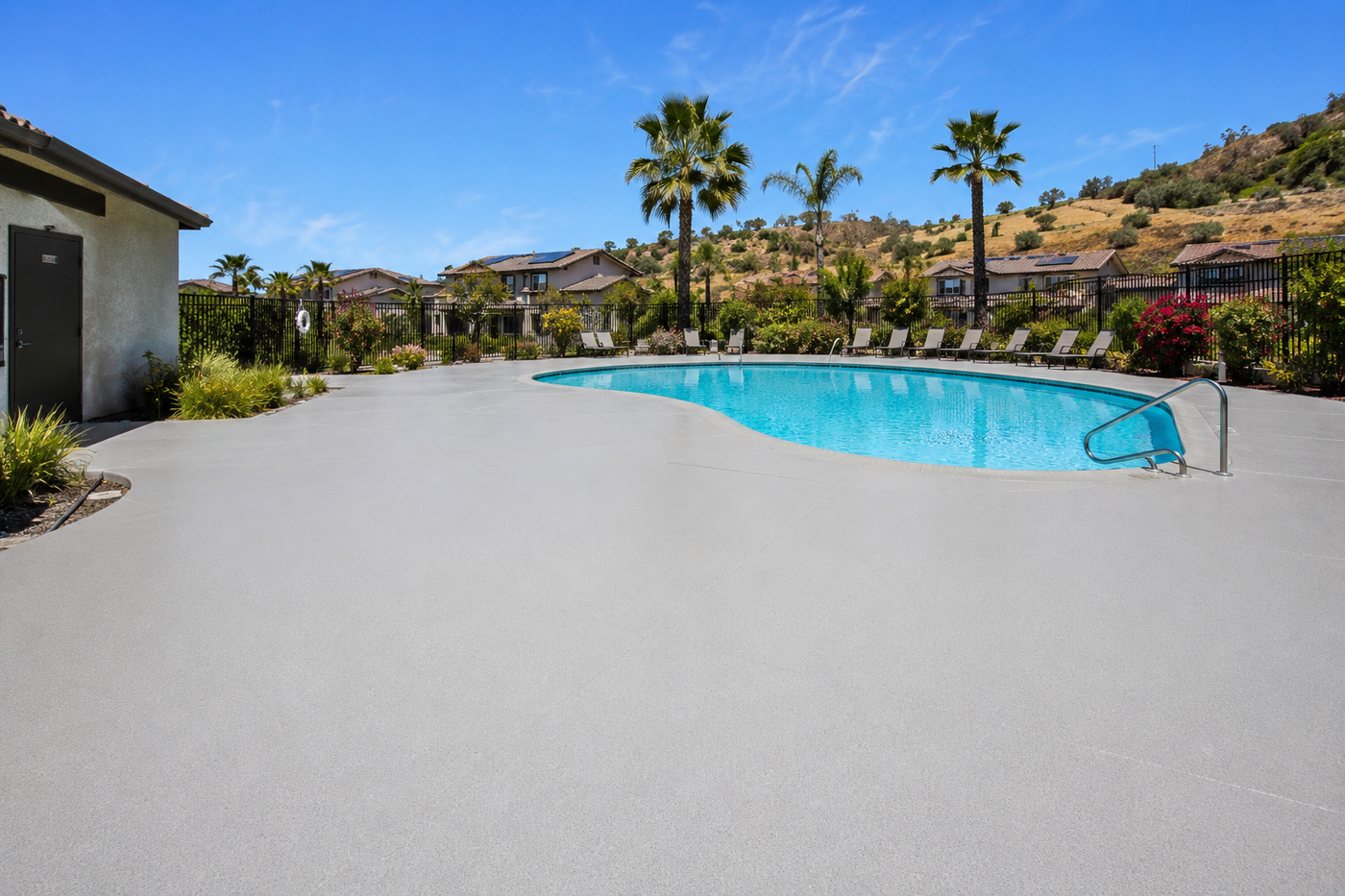
Concrete is one of the most durable building materials available — but durable doesn't mean maintenance-free. Driveways, walkways, pool decks, and common area hardscape on California properties take a significant amount of daily abuse: vehicle traffic, foot traffic, UV exposure, pool chemicals, water intrusion, freeze-thaw cycles in foothill communities, and the relentless thermal expansion and contraction that comes with California's wide temperature swings.
Over time, that abuse shows. Concrete fades, stains, cracks, and spalls. Unsealed surfaces absorb oil, water, and contaminants that are difficult or impossible to remove. Pool decks become slippery, faded, and uncomfortable underfoot in the summer heat. Driveways that were once a clean, neutral backdrop to a well-maintained home start to look tired and worn in ways that affect the entire property's curb appeal.
The solution isn't always replacement — which is expensive, disruptive, and often unnecessary. In most cases, the right coating or sealer system can protect the existing concrete, dramatically improve its appearance, extend its service life by years, and do it at a fraction of the cost of tearing out and repaving.
Here's what California property owners and HOA boards need to know about concrete and hardscape coating — what the options are, when each is appropriate, and what proper preparation and application looks like.
Why Concrete Needs Protection in California's ClimateUV Degradation
California's intense sun is as hard on concrete as it is on exterior paint. UV radiation breaks down the surface layer of uncoated concrete over time, causing it to chalk, dust, and lose its original color and surface integrity. This process — called carbonation — also affects the concrete's ability to resist moisture penetration.
Coated and sealed concrete reflects or absorbs UV radiation at the coating level rather than at the concrete surface itself, dramatically slowing this degradation process and preserving the integrity of the substrate beneath.
Moisture Intrusion and Staining
Uncoated concrete is porous. Water, oil, pool chemicals, fertilizers, and other contaminants penetrate the surface easily — causing staining that is often permanent, and carrying dissolved minerals that can cause efflorescence (the white, chalky deposits that appear on concrete surfaces as moisture migrates through and evaporates).
In areas where moisture can penetrate concrete slabs over occupied or conditioned space — pool decks over basements, podium walkways over parking structures, elevated hardscape over occupied areas — water intrusion through unprotected concrete can cause significant structural and interior damage over time.
A properly applied sealer or coating creates a barrier that prevents moisture and contaminants from penetrating the surface, making the concrete dramatically easier to clean and maintain and protecting the substrate from the inside out.
Cracking and Spalling
Concrete cracks. It's not a defect — it's a characteristic of the material. Thermal expansion and contraction, minor settling, and the natural shrinkage that occurs as concrete cures all contribute to cracking over time. In California's climate, where surface temperatures swing dramatically between summer highs and cool nights, this thermal cycling is particularly pronounced.
Unprotected cracks allow water to penetrate, which accelerates deterioration — particularly in foothill communities where freeze-thaw cycles can cause water trapped in cracks to expand and widen them. Spalling, which occurs when the surface layer of concrete breaks away, is often the result of water intrusion followed by freeze-thaw action or carbonation of the surface layer.
Coating and sealing concrete doesn't eliminate cracking, but it dramatically slows the rate at which minor cracks grow and prevents water from using them as entry points.
Concrete Coating and Sealer Options: What's Available and When to Use Each
The right product for a concrete surface depends on the specific application, the level of traffic and exposure the surface receives, the desired appearance, and whether the primary goal is protection, decoration, or both.
Penetrating Sealers
Penetrating sealers — also called impregnating sealers — work by penetrating into the pores of the concrete and chemically bonding with the substrate rather than forming a film on the surface. They provide excellent moisture and contaminant resistance without changing the appearance of the concrete — the surface looks the same after sealing as before, just slightly enriched in color.
Penetrating sealers are the right choice when:
- The primary goal is protection rather than appearance change
- A natural, matte look is desired
- The surface receives heavy vehicle traffic where a film-forming coating might peel or flake
- The concrete has a textured or exposed aggregate finish that should be preserved
Penetrating sealers are widely used on driveways, exposed aggregate walkways, and natural concrete surfaces in HOA common areas. They don't provide the dramatic visual transformation of film-forming coatings but they are extremely durable and require minimal maintenance.
Acrylic Concrete Sealers
Acrylic sealers form a thin protective film on the surface of the concrete, providing good UV resistance, moisture protection, and a range of sheen levels from matte to high gloss. They are available in clear formulations that enhance the natural color of the concrete, as well as tinted versions that add color.
Acrylic sealers are one of the most widely used concrete coating products in residential and HOA applications — they are cost-effective, relatively easy to apply, and provide a meaningful upgrade in both appearance and protection over unsealed concrete.
They are appropriate for:
- Driveways and walkways where a moderate level of protection and improved appearance is the goal
- Pool decks where a slip-resistant texture can be incorporated into the sealer
- Common area hardscape where a clean, consistent appearance is desired
Acrylic sealers typically require reapplication every two to four years depending on traffic levels and exposure conditions. They are not the most durable option for heavy vehicle traffic or pool chemical exposure but represent an excellent value for most residential and HOA applications.
Epoxy Coatings
Epoxy coatings are two-component products — a resin and a hardener mixed immediately before application — that cure to an extremely hard, durable, chemically resistant film. They provide superior protection against oil, fuel, pool chemicals, and heavy traffic, and are available in a wide range of colors and decorative finishes including chip systems and metallic effects.
Epoxy coatings are most commonly used on:
- Garage floors where oil resistance and durability are the primary requirements
- Pool equipment pads and mechanical areas where chemical resistance is important
- Commercial and industrial floor applications
The tradeoff with epoxy is that it requires very thorough surface preparation — typically acid etching or mechanical grinding to open the surface profile and ensure adequate adhesion — and can be unforgiving of moisture in the substrate, which can cause delamination. Epoxy also tends to amber (yellow) with UV exposure over time, making it less appropriate for exterior horizontal surfaces in direct sun.
Polyurea and Polyaspartic Coatings
Polyurea and polyaspartic coatings represent the current high-performance end of the concrete coating market. They combine the durability and chemical resistance of epoxy with significantly better UV stability, making them appropriate for exterior applications where epoxy would amber and degrade.
Polyaspartic coatings in particular have become the preferred system for garage floors and exterior hardscape in high-performance applications — they cure quickly, resist UV yellowing, handle temperature extremes well, and are available in a full range of decorative finishes.
These products require professional application — the fast cure times that make them efficient also mean there is little margin for error during application — but they deliver exceptional long-term performance in California's demanding climate.
Pool Deck Coatings
Pool decks present a unique set of requirements: slip resistance for wet bare feet, heat reflectivity to keep the surface comfortable in California's summer sun, chemical resistance to pool water and treatments, and attractive appearance.
Dedicated pool deck coating systems — typically acrylic-based with a texture broadcast or knockdown finish — address all of these requirements simultaneously. These systems are applied over properly prepared concrete and create a comfortable, slip-resistant, UV-stable surface that dramatically improves the safety and appearance of the pool area.
Spray-applied texture finishes like Kool Deck and similar products are widely used in California and are specifically formulated to stay cooler underfoot than uncoated concrete — an important consideration when barefoot pool users are crossing the deck on a 105°F Bakersfield summer afternoon.
Surface Preparation: The Non-Negotiable Foundation
As with every exterior coating application, the performance of a concrete coating system is entirely dependent on the quality of the surface preparation beneath it. Concrete surfaces present specific preparation challenges that must be addressed before any coating is applied.
Cleaning
Concrete surfaces must be thoroughly cleaned before coating — removing dirt, oil, grease, biological growth, efflorescence, and any existing sealer or coating that is failing or incompatible with the new system. Pressure washing is the standard first step, often combined with chemical degreasers for oil-contaminated surfaces and acid washing or etching to open the surface profile for penetrating sealers and film-forming coatings.
Crack Repair
Existing cracks should be assessed and addressed before coating. Narrow hairline cracks in stable concrete can often be filled with a flexible crack filler or left for the coating to bridge. Wider or actively moving cracks should be routed and filled with a flexible polyurethane or epoxy crack repair product before the coating system is applied.
Coating over unrepaired cracks doesn't make them disappear — it telegraphs them through the coating and creates a point of vulnerability where water can still work its way beneath the surface.
Surface Profile
Most film-forming concrete coatings require a minimum surface profile — a slight roughness at the microscopic level — to achieve adequate adhesion. On smooth or trowel-finished concrete, this profile must be created mechanically through grinding or shot blasting, or chemically through acid etching, before primer or coating application.
Applying a film-forming coating to a concrete surface that hasn't been properly profiled is one of the most common causes of delamination — the coating simply doesn't have enough surface area to bond to and peels away under traffic or thermal stress.
Moisture Testing
Moisture in the concrete substrate is the enemy of many coating systems — particularly epoxy, which can blister and delaminate if applied over concrete with elevated moisture vapor emission. Professional contractors test for moisture before specifying a coating system, and select products rated for the moisture conditions present in the slab.
What to Expect From a Professional Concrete Coating Project
A professional concrete coating project on a residential driveway, HOA walkway, or pool deck follows a defined sequence:
Day one: Preparation. Pressure washing, degreasing, crack repair, and surface profiling. This is the most labor-intensive day and the foundation of the entire project.
Inspection and repair review. Once the surface is clean and dry, a thorough inspection identifies any remaining conditions that need to be addressed before coating begins.
Primer application. Where required by the coating system, primer is applied and allowed to cure to the manufacturer's specified timeframe.
Coating application. The specified coating system is applied in the number of coats required to achieve the desired film thickness and appearance. Decorative elements — color chips, texture broadcasts, decorative aggregates — are incorporated at the appropriate stage.
Cure time. Concrete coatings require adequate cure time before the surface is returned to foot or vehicle traffic. This varies by product — acrylic sealers may be ready for foot traffic in a few hours, while epoxy and polyaspartic systems may require 24 hours or more before vehicle traffic is permitted.
HOA Communities: Hardscape as a Community Asset
For HOA communities, the condition of common area hardscape — walkways, pool decks, entry plazas, and recreational areas — is a significant contributor to the community's overall appearance and the experience of residents and visitors.
Hardscape that is stained, faded, cracked, or slippery creates both aesthetic and liability concerns. Including hardscape coating and maintenance in the community's exterior maintenance plan — on a defined inspection and recoat cycle — ensures these surfaces remain safe, attractive, and functional assets rather than deferred maintenance liabilities.
At Whitestone Industries, we assess hardscape conditions as part of our property condition evaluations for HOA communities and incorporate concrete coating scopes into multi-year exterior maintenance plans where appropriate.
The Whitestone Approach
At Whitestone Industries, we bring the same commitment to preparation and product quality to concrete and hardscape coating that we apply to every exterior surface we work on. We assess existing conditions, specify the preparation method and coating system appropriate to the specific application, and apply products selected for California's climate and the exposure conditions of each property.
Whether you're looking to protect and refresh a residential driveway, restore a community pool deck, or coat and seal common area walkways across an HOA community, we have the experience and the product knowledge to deliver a result that performs as well as it looks.
Contact Whitestone Industries today to schedule a free assessment and estimate for your concrete and hardscape coating project.
Whitestone Industries serves HOAs, multifamily property owners, and commercial properties throughout California with commercial and multi-family services, commercial roofing, SB 326 and SB 721 consulting and repairs, construction defect and destructive testing, and residential services. Call us at 888-567-2234 or visit wsindustries.com.