
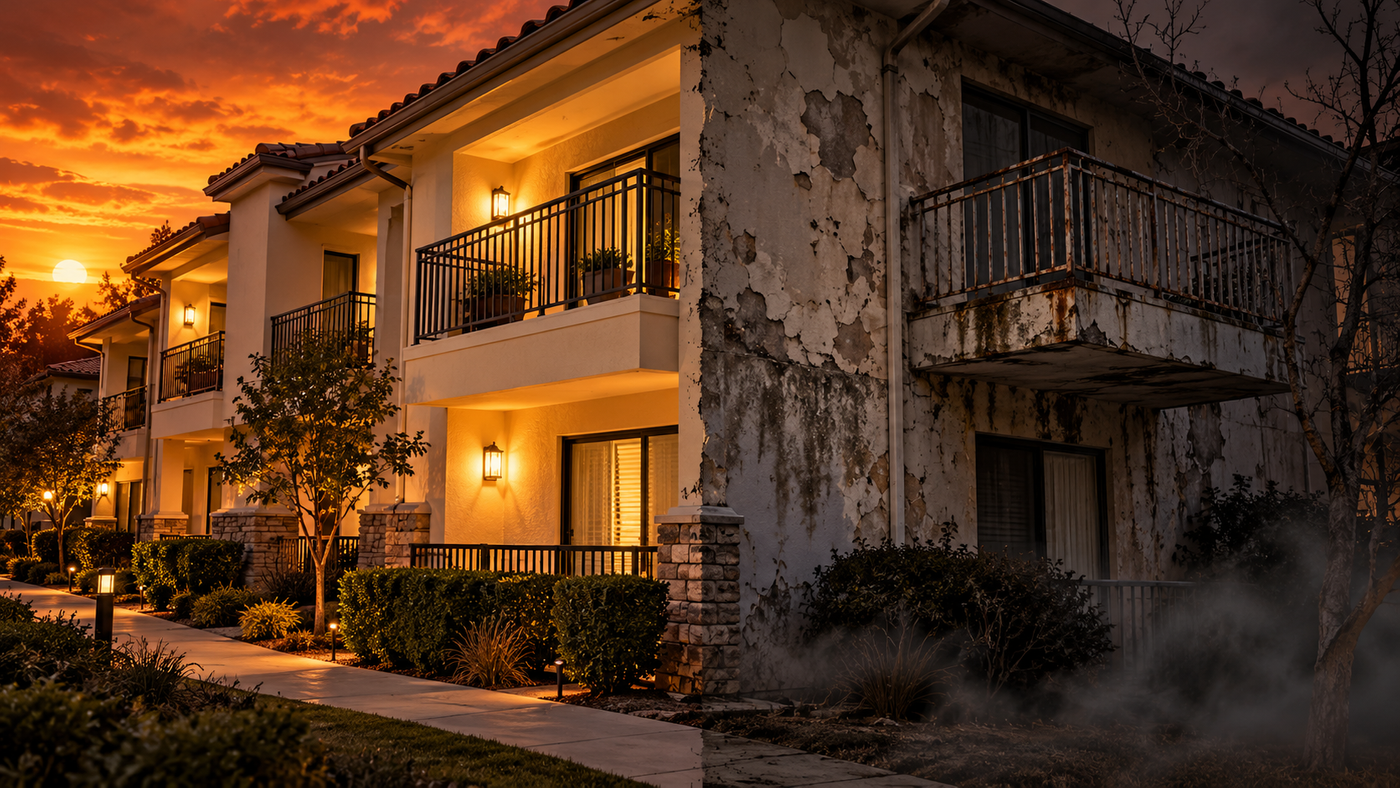
It's the season for things that go bump in the night. But if you own or manage a multifamily property or commercial building in California, the scariest things aren't hiding under your bed — they're hiding behind your stucco, beneath your balcony decks, and inside your wall assemblies.
Unlike a haunted house, these horrors don't disappear on November 1st. They get worse. And the longer they stay hidden, the more expensive they become to fix.
In the spirit of the season, here are five genuinely frightening things that may be lurking on your building's exterior right now — and what to do before they turn into a full-blown nightmare.
👻 #1: The Ghost in the Wall — Water Intrusion You Can't See Yet
Water damage is the ultimate haunting. It moves silently through your building's envelope, invisible behind intact stucco and freshly painted surfaces, doing its work in the dark — rotting framing, saturating insulation, and feeding mold before a single interior stain appears.
By the time water damage shows up on a wall or ceiling inside a unit, it has often been active for months or years. The entry point is almost always on the exterior: a failed caulk joint around a window, a crack in the stucco that opened during last summer's heat, a flashing detail that shifted just enough to let water in at the roof edge.
The ghost in the wall doesn't announce itself until the damage is done.
What to do: A professional exterior inspection before the rainy season — looking closely at caulk joints, stucco condition, flashing details, and window perimeters — identifies the entry points before water finds them. Sealing those points costs a fraction of what interior remediation does.
🕷️ #2: The Creature Beneath the Deck — Failed Waterproofing on Elevated Surfaces
Balcony and deck waterproofing membranes have a surface appearance that can be deeply misleading. A deck can look perfectly intact from above — no visible cracks, no obvious damage — while the membrane beneath the surface has delaminated, blistered, and completely lost its ability to prevent water from reaching the structural deck below.
Water that penetrates a failed membrane doesn't drain away. It sits against the structural framing, the ledger connection, and the concrete or plywood substrate — day after day, rain after rain — causing corrosion, rot, and deterioration that won't be visible until someone opens things up.
Under California's SB 326 and SB 721, elevated elements with failed waterproofing are among the most commonly cited findings — and among the most costly to remediate when the structural damage beneath them has been allowed to progress.
What to do: If your balcony or deck waterproofing membranes haven't been inspected in the last few years, now is the time. The cost of a membrane inspection and targeted repair is a small fraction of what a full structural rehabilitation requires.
🦇 #3: The Rot You Never Knew Was There — Wood Decay Behind Intact Finishes
Wood rot is a master of disguise. It develops in the dark, in the moisture, behind surfaces that look completely fine from the outside. Fascia boards, window sill framing, balcony ledger connections, and stair stringers can be significantly decayed while their painted surfaces appear intact.
This is how rot works: water finds its way into a concealed space — through a gap in caulking, through a crack in stucco, through a flashing that has shifted — and saturates wood framing that never fully dries out. Fungal decay begins and spreads through the framing, often for years, while the paint or stucco finish on the outside looks perfectly normal.
Contractors discover this all the time when they open up a repair area that appeared to be a minor stucco patch and find framing that needs to be replaced entirely.
What to do: Areas showing signs of moisture infiltration — staining, efflorescence, soft spots in stucco, paint bubbling near windows or at deck edges — are worth investigating before winter. These are the signals that rot may already be developing behind the surface.
🕸️ #4: The Ticking Time Bomb — Clogged Roof Drains and Blocked Gutters
Flat and low-slope roofs depend entirely on their drainage systems to move water off the surface. When roof drains are clogged with debris — leaves, dirt, bird nesting material — water that should drain within hours after a rain event instead ponds on the roof surface for days.
Ponding water on a flat roof is one of the most damaging conditions a roofing system can experience. It adds significant weight load to the structure, accelerates membrane deterioration at the ponding location, and creates hydrostatic pressure that forces water through any vulnerability in the membrane or flashings.
Gutters and downspouts on pitched roofs present the same risk when clogged — water backs up under the roofing material, saturates the fascia and soffit, and finds its way into the wall assembly at the eave line.
After a dry California summer, roof drains and gutters are often packed with debris that accumulated over months without rain to flush them. The first significant rain of the season tests whether that drainage system is ready — and a clogged system often fails that test spectacularly.
What to do: Roof drain clearing and gutter cleaning before the rainy season is one of the highest-value, lowest-cost maintenance items a property owner can perform. It takes a few hours and can prevent thousands of dollars in water damage from a single storm event.
💀 #5: The Spreading Curse — Rust Beneath Painted Metal
Iron and steel surfaces on your building — railings, fences, gates, light poles, metal doors — are protected from corrosion by their paint coating. But paint on metal doesn't last forever, and when it begins to fail, rust doesn't wait around.
What makes rust particularly insidious is how it spreads beneath the surface. A small rust spot on a painted railing isn't just a cosmetic issue — it's the visible tip of a corrosion process that is actively spreading beneath the paint film, lifting the coating from the metal surface as it expands. By the time you can see the rust, it has usually already traveled well beyond the visible area.
On structural elements — stair railings, balcony guardrails, handrails — corrosion isn't just an aesthetic problem. It's a safety concern. Metal that has been significantly corroded loses structural integrity, and on elements that people depend on for safety, that's a liability exposure no property owner wants.
What to do: Metal surfaces showing any rust breakthrough, paint bubbling, or coating failure should be addressed before the condition progresses. Proper remediation involves removing all rust mechanically, treating the surface with a rust-inhibiting primer, and applying a quality topcoat formulated for exterior metal. Catching it early — when the rust is localized — is dramatically less expensive than addressing widespread corrosion later.
Don't Let These Horrors Haunt You All Winter
The good news is that none of these scary conditions are inevitable — and all of them are significantly more manageable when they're caught early. A professional exterior inspection before the rainy season gives you a clear picture of what's lurking on your building's exterior, so you can address the real threats before winter arrives.
At Whitestone Industries, we conduct pre-season exterior assessments for HOAs, multifamily properties, and commercial buildings throughout California. We know what to look for, where to look, and what it will take to address conditions before they turn into something truly frightening.
Contact Whitestone Industries today to schedule your pre-winter exterior inspection — and find out what's really hiding on your building before the rains do.
Whitestone Industries serves HOAs, multifamily property owners, and commercial properties throughout California with commercial and multi-family services, commercial roofing, SB 326 and SB 721 consulting and repairs, construction defect and destructive testing, and residential services. Call us at 888-567-2234 or visit wsindustries.com.